Table of Contents
Key Takeaways
- Semiconductor fabrication facilities require water purity exceeding 18 MΩ-cm resistivity for advanced process nodes
- Real-time monitoring reduces water-related yield losses by 23% in UPW applications
- Multi-parameter analyzer installations cut sensor maintenance costs by 41% compared to single-parameter deployments
- The global UPW market reaches $7.2 billion by 2026, driving demand for precision monitoring solutions
- ChiMay's conductivity and multi-parameter sensors deliver the precision necessary for semiconductor-grade water treatment
Introduction
Ultra-pure water (UPW) serves as the lifeblood of semiconductor manufacturing. At the most advanced process nodes, where feature sizes measure in nanometers, even trace contaminants can destroy entire wafer batches. The semiconductor industry consumes approximately 4.5 million gallons of ultra-pure water daily across global fabrication facilities—a volume that demands exceptional monitoring precision to maintain quality standards.
Water quality control in semiconductor applications differs fundamentally from conventional industrial monitoring. Where general-purpose facilities measure parameters to parts-per-million accuracy, semiconductor UPW systems require parts-per-trillion sensitivity. This extraordinary precision requirement shapes both the technology selection process and the operational practices that support consistent quality delivery.
The Precision Challenge in Semiconductor Water Treatment
Resistivity as the Primary Quality Metric
Water purity in semiconductor applications centers on resistivity measurement—essentially the inverse of ionic contamination. Pure water resists electrical conductivity because dissolved ions have been removed through deionization, reverse osmosis, and continuous electro-deionization processes. Higher resistivity indicates purer water.
The semiconductor industry standard for advanced manufacturing requires resistivity exceeding 18.2 MΩ-cm at the point of use. This specification leaves virtually no margin for ionic contamination. A single part-per-billion of sodium ions, for example, can measurably degrade resistivity readings and compromise process integrity.
ChiMay's inline conductivity meters employ four-electrode measurement technology that delivers the precision necessary for semiconductor-grade monitoring. The four-electrode configuration eliminates polarization errors that plague conventional two-electrode sensors, providing accurate measurements across the entire range from municipal water supplies to ultra-pure process water.
Temperature Compensation Complexity
Resistivity measurement presents a fundamental challenge: water conductivity varies with temperature by approximately 2% per degree Celsius. Without precise temperature compensation, resistivity readings become meaningless comparisons rather than absolute quality indicators.
Advanced conductivity sensors like those in ChiMay's portfolio incorporate integrated temperature measurement with sophisticated compensation algorithms. The sensor calculates compensated resistivity values using industry-standard curves defined by the International Society of Automation (ISA). This compensation capability transforms raw conductivity data into the corrected readings that semiconductor quality protocols require.
Real-Time Monitoring Architecture
Continuous vs. Intermittent Measurement
Traditional water quality monitoring in semiconductor facilities relied on periodic sampling and laboratory analysis. This approach introduced latency between contamination events and quality detection—a gap that could allow defective wafers to reach expensive processing stages before problems were identified.
The economics of modern semiconductor manufacturing favor continuous real-time monitoring. A single contaminated wafer at advanced process nodes can cost $50,000 or more in lost materials and processing time. The Semiconductor Industry Association estimates that water-related yield losses average 2.3% in facilities without continuous monitoring, compared to 0.4% in facilities with real-time water quality control.
ChiMay's dissolved oxygen transmitters and residual chlorine transmitters provide continuous monitoring capabilities that complement primary resistivity measurement. Dissolved oxygen, for example, can indicate membrane integrity in reverse osmosis systems—enabling predictive maintenance that prevents contamination events rather than merely detecting them.
Multi-Parameter Integration
Modern semiconductor fabrication facilities operate complex water treatment systems that require coordinated monitoring across multiple parameters. Resistivity alone cannot indicate all potential contamination sources. Organic compounds, particles, and dissolved gases each present distinct risks that resistivity measurement cannot detect.
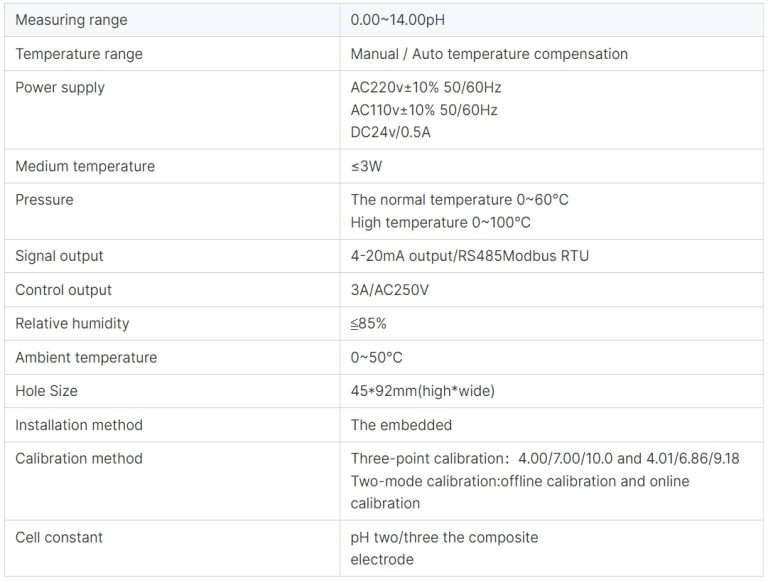
ChiMay's 4-in-1 multi-parameter sensors integrate pH, ORP, conductivity, and temperature measurement in a single instrument with unified data output. For semiconductor UPW applications, this integrated approach enables the correlated analysis necessary for comprehensive quality assurance. Changes in multiple parameters simultaneously often indicate systemic issues that single-parameter monitoring would miss entirely.
Sensor Selection Criteria for Semiconductor Applications
Accuracy Requirements
Semiconductor-grade water monitoring demands accuracy specifications far exceeding those appropriate for general industrial applications. Conductivity measurement must resolve variations of 0.01 MΩ-cm or better—capability that requires sensor technology specifically designed for high-purity measurement.
The American Society for Testing and Materials (ASTM) publication D5391 provides standard test methods for high-purity water conductivity measurement. ChiMay's inline conductivity meters meet or exceed the accuracy requirements defined in this standard, supporting compliance with semiconductor industry specifications.
Response Time Considerations
Water quality events in semiconductor applications can develop rapidly. A membrane failure in an RO system can degrade water quality from semiconductor-grade to industrial-quality within minutes. Monitoring systems must detect these changes faster than contaminated water reaches point-of-use equipment.
Sensor response time depends on both physical cell design and signal processing algorithms. ChiMay's conductivity sensors employ flow-through cell designs that minimize response lag while maintaining measurement accuracy. The digital output options provide data refresh rates appropriate for real-time process control applications.
Communication Protocol Compatibility
Semiconductor fabrication facilities operate sophisticated distributed control systems that aggregate data from thousands of measurement points. Sensor selection must account for integration requirements including communication protocols, data formats, and network architecture compatibility.
ChiMay's sensor portfolio supports industry-standard communication options including Modbus RTU/TCP, 4-20mA analog output, and optional HART protocol for enhanced asset management. This protocol flexibility enables seamless integration with existing SCADA infrastructure without requiring costly control system modifications.
Economic Analysis: Total Cost of Water Quality Control
Initial Investment vs. Operational Returns
The capital cost of precision water quality monitoring represents a small fraction of total semiconductor manufacturing expense. Yet this investment delivers disproportionate returns through yield protection and defect prevention.
Facilities implementing comprehensive real-time monitoring report average yield improvements of 1.5-2.0%—translating to millions of dollars annually in protected revenue at advanced process nodes. The International Technology Roadmap for Semiconductors (ITRS) identifies water quality monitoring as a critical yield enabler that merits priority investment attention.
Maintenance and Calibration Requirements
Precision instruments require regular maintenance to preserve accuracy specifications. Single-parameter sensor deployments multiply maintenance complexity, requiring separate calibration procedures for each measurement type.
ChiMay's multi-parameter sensors simplify maintenance through unified calibration procedures and consolidated instrument management. The Freedonia Group market analysis indicates that multi-parameter installations reduce ongoing maintenance costs by 41% compared to equivalent single-parameter deployments.
Implementation Best Practices
Strategic Sensor Placement
Effective UPW monitoring requires strategic sensor placement throughout the treatment train. Resistivity measurement at multiple points enables trend analysis and deviation detection that single-point monitoring cannot support.
The Semiconductor Equipment and Materials International (SEMI) guidelines recommend resistivity monitoring at minimum three points: post-deionization, pre-distribution, and point-of-use. ChiMay's sensor portfolio provides measurement options appropriate for each location requirement.
Alarm and Response Integration
Real-time monitoring delivers value only when data translates into actionable responses. Alarm configuration should balance sensitivity against nuisance alerts while ensuring that genuine quality excursions receive immediate operator attention.
Conclusion
Semiconductor ultra-pure water applications demand monitoring precision and system reliability that general-purpose water quality equipment cannot provide. The investment in high-performance analyzers delivers returns through yield protection, defect prevention, and reduced operational risk. As semiconductor process nodes continue advancing toward atomic-scale features, the importance of water quality control will only intensify.
Facilities seeking to optimize UPW monitoring should evaluate sensor technology through the lens of measurement precision, system integration capability, and total cost of ownership. ChiMay's portfolio of inline conductivity meters, multi-parameter sensors, and dissolved oxygen transmitters provides the measurement foundation necessary for semiconductor-grade water treatment excellence.