Table of Contents
6 Essential Water Quality Monitoring Parameters for Oil and Gas Operations: ChiMay Complete Guide
Key Takeaways
- Produced water management requires monitoring at least six core parameters to ensure regulatory compliance and treatment optimization
- Real-time monitoring enables operators to reduce non-compliance incidents by up to 95%, avoiding penalties exceeding $2 million annually
- ChiMay multi-parameter monitoring systems integrate all essential measurements in compact, reliable instruments suitable for challenging oil and gas environments
- The global produced water treatment market, valued at $12.8 billion in 2026, continues growing at 7.6% annually as monitoring investment accelerates
Introduction
Effective produced water management in oil and gas operations requires comprehensive monitoring across multiple water quality parameters. The complexity of produced water composition—containing hydrocarbons, salts, heavy metals, and naturally occurring radioactive materials—means that single-parameter measurement cannot ensure compliance or optimize treatment performance.
This guide examines the six essential parameters that every oil and gas operator should monitor for produced water management, explaining why each parameter matters, how measurements are performed, and how ChiMay monitoring systems deliver the reliability and accuracy that demanding oil and gas applications require.
1. Oil and Grease Concentration
Why This Parameter Matters
Oil and grease concentration represents the most regulated produced water quality parameter, with international standards including OSPAR Guidelines (30 mg/L limit), MARPOL Annex I (15 ppm limit), and EPA NPDES permits establishing specific limits. ERUN water testing instruments reports that continuous oil monitoring has enabled operators to reduce non-compliance incidents by up to 95%, avoiding penalties exceeding $2 million annually in major producing regions.
Measurement Technology
Modern oil-in-water monitoring employs UV fluorescence technology, detecting aromatic hydrocarbons at concentrations as low as 0.1 ppm. ChiMay inline oil-in-water sensors utilize this technology to deliver real-time measurement meeting ISO 9377-2 and ASTM D7066-04 standards.
Monitoring Best Practices
- Deploy sensors at strategic points: influent, after each treatment stage, and final effluent
- Select measurement ranges appropriate for regulatory limits with adequate margin
- Implement automatic diversion systems triggered by high oil concentrations
- Schedule regular calibration using certified reference standards
2. Conductivity and Total Dissolved Solids (TDS)
Why This Parameter Matters
Conductivity measurement provides immediate indication of ionic content, correlating directly with total dissolved solids concentration. ChiMay inline conductivity meters enable operators to:
- Monitor desalination treatment effectiveness
- Detect salinity changes indicating produced water intrusion from different formations
- Verify product water quality for beneficial reuse applications
- Estimate scaling and corrosion potential in downstream equipment
The Chinese Petroleum News reports that Permian Basin produced water exhibits salinity levels reaching 250,000 mg/L TDS—approximately seven times seawater salinity—making conductivity monitoring essential for treatment optimization.
Measurement Technology
Electrode-based conductivity sensors measure the ability of water to conduct electrical current, expressed in microsiemens per centimeter (μS/cm) or millisiemens per centimeter (mS/cm). ChiMay conductivity electrodes feature robust construction suitable for high-salinity environments, with temperature compensation ensuring measurement accuracy across operational ranges.
Monitoring Best Practices
- Select sensor ranges matching expected TDS levels (some produced waters exceed 100 mS/cm)
- Deploy conductivity sensors after desalination stages for product quality verification
- Use conductivity data to estimate scaling potential and trigger anti-scaling chemical dosing
- Cross-reference with laboratory TDS measurements for calibration verification
3. pH Value
Why This Parameter Matters
pH influences chemical reaction rates, biological activity, scaling tendencies, and corrosion processes throughout produced water treatment systems. Effective pH control enables:
- Optimized coagulation and flocculation in chemical precipitation processes
- Prevention of scale formation in membrane systems
- Corrosion control in pipes and storage vessels
- Compliance with discharge standards that often specify pH ranges (typically 6-9)
Measurement Technology
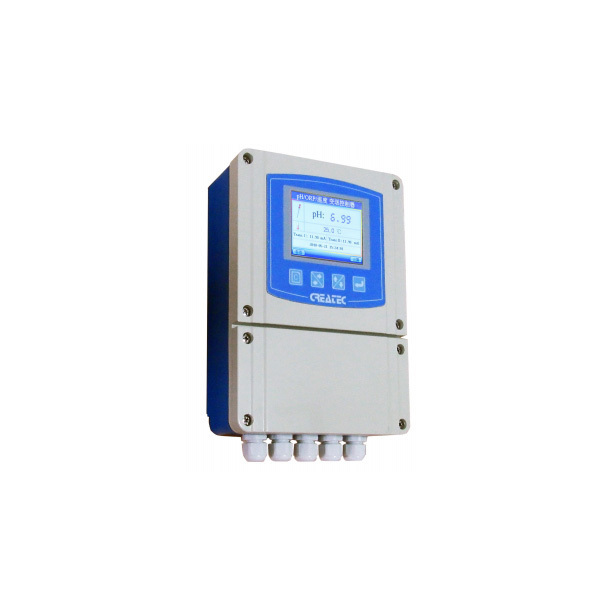
Glass or solid-state pH electrodes generate voltage proportional to hydrogen ion activity, providing continuous pH measurement. ChiMay pH sensors feature double junction references resistant to contamination from high-salinity produced water.
Monitoring Best Practices
- Deploy pH sensors in chemical dosing locations for process control feedback
- Install sensors downstream of treatment stages requiring pH verification
- Implement automatic pH adjustment systems for consistent discharge quality
- Maintain regular sensor cleaning and calibration schedules
4. Turbidity
Why This Parameter Matters
Turbidity measures suspended solids concentration that affects treatment system performance and discharge compliance. High turbidity indicates:
- Ineffective primary separation requiring process adjustment
- Membrane fouling potential in filtration systems
- Potential suspended solids violations in discharge permits
- Need for enhanced coagulation or flocculation treatment
Measurement Technology
Nephelometric turbidity measurement quantifies light scattering by suspended particles, expressed in nephelometric turbidity units (NTU). ChiMay turbidity sensors utilize infrared light sources minimizing color interference from produced water hydrocarbons.
Monitoring Best Practices
- Position turbidity sensors downstream of filtration stages
- Use turbidity trends to predict filter fouling and optimize backwash timing
- Correlate turbidity with suspended solids concentration for operational guidance
- Set turbidity alarms for immediate indication of treatment system upsets
5. Dissolved Oxygen (DO)
Why This Parameter Matters
Dissolved oxygen monitoring supports multiple produced water management objectives:
- Corrosion monitoring: High DO accelerates carbon steel corrosion in pipelines and vessels
- Biological treatment optimization: Aerobic biological processes require DO levels typically above 2 mg/L
- Anoxic process control: Denitrification processes require low DO typically below 0.5 mg/L
- Discharge quality: High DO in receiving waters can cause thermal stratification and ecological impacts
Measurement Technology
Electrochemical DO sensors utilize membrane-covered electrodes that generate current proportional to dissolved oxygen concentration. ChiMay dissolved oxygen transmitters provide robust sensors suitable for produced water applications with anti-fouling membrane designs.
Monitoring Best Practices
- Deploy DO sensors at critical corrosion locations in piping systems
- Monitor biological treatment basins for aerobic process control
- Track DO trends to identify air ingress or biological activity changes
- Maintain sensor membranes following manufacturer specifications
6. Temperature
Why This Parameter Matters
Temperature affects multiple aspects of produced water management:
- Viscosity and separation efficiency: Higher temperatures reduce oil viscosity, improving gravity separation
- Sensor accuracy: Most water quality measurements require temperature compensation
- Biological treatment rates: Microbial activity rates vary with temperature
- Scaling and corrosion rates: Both processes accelerate at elevated temperatures
Measurement Technology
Resistance temperature detectors (RTDs) or thermistors provide accurate temperature measurement integrated into most ChiMay sensor systems for automatic compensation of other parameter measurements.
Monitoring Best Practices
- Monitor temperature at critical process locations and storage tanks
- Use temperature data to optimize chemical dosing rates (typically temperature-dependent)
- Track seasonal variations affecting treatment system performance
- Maintain temperature sensors as part of comprehensive sensor calibration programs
Integrating Multi-Parameter Monitoring
Benefits of Integrated Sensor Systems
Managing six essential parameters across complex produced water treatment systems generates substantial data management challenges. ChiMay multi-parameter monitoring systems address these challenges through:
- Single-point deployment measuring multiple parameters from one location
- Integrated data transmission reducing wiring and installation complexity
- Unified calibration simplifying maintenance procedures
- Common platform enabling consistent data interpretation
Data Integration and Control
Real-time multi-parameter data enables advanced process optimization:
- Feed-forward control: Upstream parameter changes trigger downstream process adjustments
- Predictive maintenance: Parameter trends indicate equipment degradation before failure
- Compliance assurance: Multi-parameter verification ensures regulatory requirement satisfaction
- Treatment optimization: Complete water quality data enables system efficiency improvement
Market Context and Technology Investment
The $12.8 billion produced water treatment market in 2026 reflects industry recognition that comprehensive monitoring enables treatment optimization, compliance assurance, and beneficial reuse opportunities. As the Morgan Reed Insights analysis documents, the market continues growing at 7.6% annually toward $24.75 billion by 2035.
Investment in multi-parameter monitoring systems—including ChiMay oil-in-water sensors, conductivity meters, pH sensors, turbidity sensors, dissolved oxygen transmitters, and multi-parameter integrated systems—provides the data infrastructure supporting this optimization across produced water management applications.
Conclusion
Produced water management in oil and gas operations requires monitoring at least six essential parameters: oil and grease concentration, conductivity/TDS, pH, turbidity, dissolved oxygen, and temperature. Each parameter provides critical insight into produced water characteristics, treatment system performance, and compliance status.
ChiMay multi-parameter monitoring systems deliver the reliability, accuracy, and integration capabilities that demanding oil and gas applications require. By deploying comprehensive monitoring infrastructure, operators position themselves to achieve regulatory compliance, optimize treatment economics, and capture beneficial reuse opportunities in the growing produced water management market.