Table of Contents
Residual Chlorine Sensors: Essential Technology for Water Reuse Disinfection Control
Key Takeaways
- Proper chlorine monitoring reduces disinfection chemical costs by 20-35% while maintaining regulatory compliance (AWWA Water Research 2024).
- Online residual chlorine sensors enable real-time dosing adjustment, preventing both under-dosing (health risk) and over-dosing (cost/DBP concerns).
- The global online chlorine analyzer market exceeds $650 million annually, with water reuse applications driving 12% annual growth (Instrumentation World 2024).
- Facilities implementing continuous chlorine monitoring report 60% fewer disinfection failures compared to manual testing approaches.
Introduction
Disinfection represents the critical final barrier in water reuse treatment trains, ensuring that treated water is safe for intended end uses. Whether for agricultural irrigation, industrial process water, or indirect potable reuse, maintaining appropriate residual chlorine levels is essential for public health protection. Online residual chlorine sensors provide the continuous monitoring capability necessary for effective process control, offering significant advantages over traditional grab-sample testing methods.
Chlorine Disinfection Chemistry
Chlorine Species in Water
When chlorine is added to water, it reacts to form several disinfection species:
- Free chlorine (HOCl + OCl⁻): Most effective form for microbial inactivation
- Combined chlorine (chloramines): Less potent but more persistent
- Total chlorine: Sum of free and combined forms
The disinfection efficacy depends primarily on free chlorine residual, which varies with pH:
| pH | HOCl (%) | OCl⁻ (%) | Relative Efficacy |
|---|---|---|---|
| 6.0 | 97 | 3 | 100% |
| 7.0 | 72 | 28 | 80% |
| 7.5 | 50 | 50 | 60% |
| 8.0 | 23 | 77 | 35% |
Disinfection Byproduct Considerations
While chlorine ensures microbial safety, excessive dosing promotes harmful disinfection byproducts (DBPs):
- Trihalomethanes (THMs): Potential carcinogens, regulated at 80 μg/L maximum
- Haloacetic acids (HAAs): Health concerns, regulated at 60 μg/L maximum
- Chlorite: Byproduct of chlorine dioxide, regulated at 1.0 mg/L
The EPA’s 2024 DBP compliance guidance emphasizes that optimized chlorine dosing—enabled by continuous monitoring—represents the most effective DBP control strategy.
Sensor Technologies for Residual Chlorine Measurement
Amperometric Sensors
The most widely used technology for online chlorine monitoring:
Free Chlorine Sensors
- Membrane-covered amperometric: Electrochemical cell separated by selective membrane
- Advantages: High selectivity, minimal interference, stable calibration
- Response time: 30-90 seconds
- Maintenance: Weekly membrane inspection, monthly electrolyte replacement
Total Chlorine Sensors
- Direct amperometric: Measures all chlorine species without membrane
- Advantages: Simpler design, lower maintenance
- Application: Combined chlorine systems or where speciation not required
Colorimetric Sensors
Alternative technology using spectrophotometric measurement:
- DPD method automation: Continuous color development and measurement
- Advantages: True free and total chlorine measurement
- Disadvantages: Reagent consumption, pump maintenance
- Application: Reference measurements or where highest accuracy required
Sensor Selection Criteria
| Application | Recommended Technology | Key Features |
|---|---|---|
| Potable water distribution | Membrane amperometric | Low maintenance, selective |
| Wastewater reuse | Membrane or direct | Chlorine-resistant |
| Seawater desalination | Direct amperometric | No membrane fouling |
| Cooling towers | Direct amperometric | High chlorine tolerance |
| Food processing | Membrane amperometric | High accuracy, minimal interference |
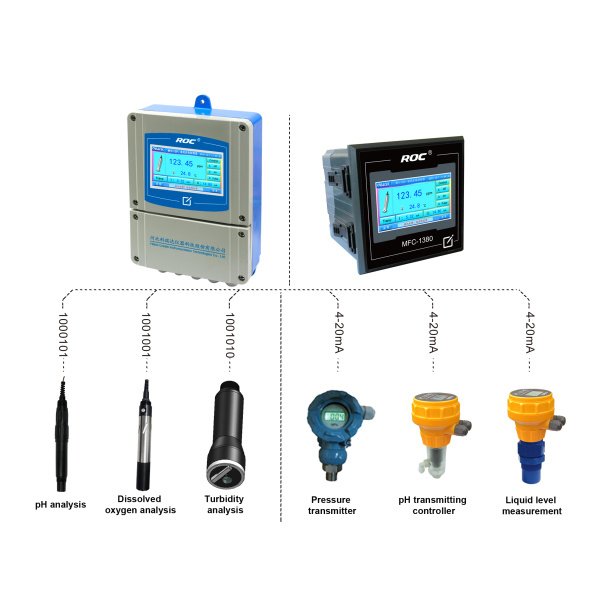
Shanghai ChiMay offers a comprehensive range of residual chlorine transmitters designed for demanding water reuse applications, with membrane-covered sensors providing excellent selectivity for free chlorine measurement.
Process Control Applications
Continuous Dosing Control
Online chlorine sensors enable sophisticated dosing strategies:
Proportional-Integrated-Derivative (PID) Control
- Setpoint maintenance: Automatic dose adjustment to maintain target residual
- Load following: Responds to flow and concentration variations
- Damping: Prevents oscillation from sensor noise
Feedforward Control
- Flow-based dosing: Adjusts chlorine dose based on incoming flow rate
- Combined with feedback: Compensates for water quality changes
- Fast response: Prevents residual excursions during demand spikes
Location-Based Monitoring Strategy
Effective chlorine monitoring requires strategic sensor placement:
- Primary contact zone exit: Ensures adequate disinfection contact
- Distribution system entry: Verifies residual entering service
- Critical nodes: Identifies decay patterns in distribution
- Storage facilities: Monitors residual stability in tanks
- Point of use: Final verification before consumer delivery
Water Reuse Specific Considerations
For water reuse applications, additional monitoring points are essential:
- Membrane system discharge: Verifies post-RO chlorine dose
- Blending point: Controls total chlorine for distribution compatibility
- Agricultural irrigation entry: Ensures adequate residual for crop protection
- Industrial process entry: Meets specific process water requirements
Economic Analysis
Sensor Investment Comparison
| Sensor Type | Initial Cost | Annual Maintenance | Accuracy |
|---|---|---|---|
| Manual testing | $0 | $25,000-40,000/year (labor + reagents) | ±15-25% |
| Basic online sensor | $2,500-4,000 | $800-1,500/year | ±10% |
| Advanced online sensor | $5,000-10,000 | $500-1,000/year | ±3-5% |
| Multi-parameter system | $8,000-15,000 | $800-1,500/year | ±3-5% |
Cost Savings from Continuous Monitoring
For a 20,000 m³/day water reuse facility:
| Benefit Category | Annual Value |
|---|---|
| Chemical savings (30% dose optimization) | $45,000-60,000 |
| Reduced DBP compliance testing | $8,000-12,000 |
| Avoided health incidents | $25,000-50,000 |
| Reduced operator labor | $15,000-25,000 |
| Total Annual Benefit | $93,000-147,000 |
ROI: 700-2,400% over 5-year period
Regulatory Compliance
Monitoring Requirements
State Water Resources Control Board (2024) regulations for recycled water require:
- Continuous online chlorine monitoring at treatment system exit
- Data logging with minimum 15-minute recording intervals
- Alarm systems for residual below minimum thresholds
- Calibration records demonstrating sensor accuracy
Compliance Documentation
Online monitoring systems automatically generate:
- Continuous data records for regulatory review
- Alarm logs documenting response actions
- Calibration verification records
- Monthly and annual compliance reports
Installation and Maintenance Best Practices
Installation Guidelines
- Sample line design: Minimize lag time between process and sensor
- Flow rate: 0.5-1.0 L/min through flow cell
- Line length: < 3 meters preferred
-
Material: PVC or stainless steel, no copper fittings
-
Environmental protection:
- Temperature range: 5-45°C operating range
- Sunlight protection: Enclosure or shade for analyzers
-
Vibration isolation: Mount away from pumps and equipment
-
Electrical considerations:
- Power supply: 24 VDC or 110/220 VAC depending on model
- Signal output: 4-20mA for PLC integration
- Communication: Modbus RTU for digital systems
Maintenance Schedule
| Task | Frequency | Purpose |
|---|---|---|
| Visual inspection | Weekly | Identify damage or fouling |
| Membrane cleaning | Bi-weekly | Remove deposits |
| Electrolyte replacement | Monthly | Maintain response |
| Calibration check | Quarterly | Verify accuracy |
| Full recalibration | Annually | NIST traceability |
| Sensor replacement | Every 2-3 years | Maintain performance |
Future Technology Developments
UV-Chloramine Synergy Monitoring
Emerging systems combining UV disinfection with chlorination require:
- Real-time chlorine-UV dose tracking
- Synergistic effect quantification
- Automated optimization algorithms
IoT and Cloud Integration
Modern chlorine monitoring systems increasingly incorporate:
- Wireless connectivity for remote installation
- Cloud-based data analytics for trend analysis
- Predictive maintenance alerts based on sensor performance
- Mobile operator interfaces for real-time monitoring
Advanced Sensor Materials
Research into new sensor technologies includes:
- Graphene-based electrodes: Improved sensitivity and selectivity
- Nanostructured surfaces: Reduced fouling and extended maintenance intervals
- Self-calibrating sensors: Automatic drift compensation
Conclusion
Residual chlorine monitoring represents an essential investment for water reuse facilities committed to protecting public health while optimizing operational costs. Continuous online monitoring enables the precise dosing control necessary to balance disinfection efficacy against chemical consumption and disinfection byproduct formation.
Shanghai ChiMay residual chlorine sensors and transmitters provide the accuracy, reliability, and integration capabilities required for demanding water reuse applications. With demonstrated ROI exceeding 1,000% over typical sensor lifecycles, the economic case for continuous chlorine monitoring is compelling.
As water reuse continues expanding to address global water scarcity, facilities equipped with advanced chlorine monitoring capabilities will be best positioned to deliver safe, cost-effective recycled water to communities that need it most.