Table of Contents
Mixed-Matrix Membranes: MOF Integration for Enhanced Separation Performance
Key Takeaways:
– Mixed-Matrix Membranes (MMMs) combining metal-organic frameworks achieve 40-60% flux enhancement versus pure polymer membranes
– MOF loadings of 15-30 wt% optimize the balance between selectivity improvement and mechanical integrity
– ZIF-8, MIL-101(Cr), and UiO-66 represent the most widely studied MOF fillers for water treatment applications
– Shanghai ChiMay monitoring equipment supports MMM system optimization and performance validation
– Commercial MMM products are projected to capture 15-20% of the advanced membrane market by 2030
Membrane technology continues evolving beyond conventional polymeric materials toward advanced composite structures that address persistent separation challenges. Mixed-Matrix Membranes (MMMs) combine the processability of polymer matrices with the superior separation properties of porous crystalline fillers, most notably metal-organic frameworks (MOFs). This integration approach has emerged as a leading strategy for developing next-generation water treatment membranes with enhanced flux, selectivity, and anti-fouling characteristics.
Metal-Organic Frameworks: Structure and Properties
MOF Fundamentals
Metal-organic frameworks are crystalline porous materials constructed from metal nodes connected by organic linkers. The modular construction approach enables extraordinary property tunability:
Porosity: Brunauer-Emmett-Teller (BET) surface areas ranging from 1,000-6,000 m²/g exceed conventional activated carbons by 10-100×
Pore Size Control: Precise aperture dimensions from 0.3-10 nm enable molecular sieving
Functional Diversity: Metal nodes (Zn, Cu, Zr, Al, etc.) and organic linkers (imidazolate, carboxylate, etc.) determine adsorption and catalytic properties
Tunable Chemistry: Post-synthetic modification enables property optimization for specific applications
Water Treatment Relevant MOFs
ZIF-8 (Zeolitic Imidazolate Framework-8): Sodalite topology with 0.34 nm aperture dimensions, exceptional chemical stability, and demonstrated removal of micropollutants including antibiotics and dyes.
MIL-101(Cr) (Materials of Institute Lavoisier): Mesoporous structure (pores up to 3.4 nm) with open metal sites enabling adsorption of large organic molecules.
UiO-66 (University of Oslo): Zirconium-based MOF with exceptional hydrothermal stability, functionalizable linkers (NH₂, NO₂, OH), and demonstrated heavy metal removal capabilities.
MIL-53(Al): Flexible framework with gate-opening behavior, responsive to external stimuli including pH and temperature variations.
MOF Synthesis Methods
Commercial MOF production methods include:
Solvothermal Synthesis: Traditional method requiring 24-72 hours at elevated temperatures. High product quality but batch processing limitations.
Microwave-Assisted Synthesis: Rapid crystallization (30-120 minutes) with narrower particle size distributions. Scalability demonstrated for ZIF-8 production.
Continuous Flow Synthesis: Enables continuous MOF production with improved consistency and reduced processing costs. ZIF-8 production costs reduced by 40-60% compared to batch solvothermal methods.
Mixed-Matrix Membrane Fabrication
Polymer Matrix Selection
Polymer matrices for MMMs must provide:
- Mechanical integrity: Withstand operational pressures (typically 5-30 bar for NF/RO)
- Processability: Enable fabrication into flat sheet, hollow fiber, or tubular configurations
- Chemical resistance: Withstand cleaning agents and variable feedwater chemistry
- Compatibility: Adequate adhesion with MOF particles
Common polymer matrices include:
| Polymer | Advantages | Limitations |
|---|---|---|
| Polysulfone (PSf) | Excellent mechanical strength, wide pH tolerance | Moderate water flux |
| Polyethersulfone (PES) | High thermal stability, good film-forming properties | Hydrophobic requiring modification |
| Polyamide (PA) | High selectivity, industry standard for RO | Limited chlorine resistance |
| PVDF | Excellent chemical resistance, good hydrophobicity | Requires hydrophilic modification |
MOF Incorporation Strategies
Physical Mixing: MOF particles dispersed in polymer solution prior to casting. Simple but prone to particle agglomeration.
In-Situ Growth: MOF crystals nucleate and grow within polymer matrix. Enhanced interfacial adhesion but process complexity.
Layer-by-Layer Assembly: Alternating polymer and MOF layers create structured interfaces. Precise control but time-intensive fabrication.
Electrospinning Integration: MOF-loaded polymer nanofibers create highly porous matrices. High surface area but limited to specific configurations.
Dispersion Optimization
Achieving uniform MOF dispersion requires attention to:
Particle Size Control: MOF particles should be 0.5-5 μm to prevent membrane defects while minimizing agglomeration.
Surface Modification: Silane coupling agents improve MOF-polymer interfacial adhesion, reducing particle settling and void formation.
Compatibility Enhancement: Grafting polymerizable groups onto MOF surfaces enables covalent bonding with matrix polymers.
Sonication Protocols: Controlled ultrasonic dispersion breaks agglomerates without damaging MOF crystal structure.
Separation Performance Enhancement
Water Flux Improvements
MOF incorporation typically increases water flux by 40-60% compared to pristine polymer membranes:
Mechanism 1 – Reduced Transport Resistance: MOF pores provide preferential water pathways with lower resistance than polymer chains
Mechanism 2 – Increased Free Volume: MOF particles disrupt polymer chain packing, creating additional free volume elements
Mechanism 3 – Hydrophilicity Enhancement: Many MOFs introduce hydrophilic functional groups improving water sorption
Mechanism 4 – Reduced Compaction: MOF particles reinforce matrix structure, reducing pressure-induced compaction
Shanghai ChiMay flow meters and pressure transmitters enable precise flux monitoring necessary for MMM performance optimization.
Selectivity Enhancement
MOF incorporation can enhance rejection of specific contaminants:
Molecular Sieving: ZIF-8 apertures (0.34 nm) exclude molecules exceeding kinetic diameter thresholds while permitting water passage
Adsorptive Removal: MOF internal surfaces adsorb contaminants that pass through polymer matrix pores
Charge Interaction: Functionalized MOFs provide electrostatic exclusion complementary to size exclusion
Anti-Fouling Properties
MOF materials provide inherent anti-fouling characteristics:
Antimicrobial Activity: Silver-containing MOFs (Ag-MIL-101) release Ag⁺ ions inhibiting bacterial growth
Hydrophilic Surfaces: Many MOFs exhibit hydrophilic character reducing organic fouling
Photocatalytic Activity: Ti-MOFs and Fe-MOFs under light irradiation generate reactive oxygen species degrading foulants
Water Treatment Applications
Pharmaceutical Wastewater
MMMs address pharmaceutical micropollutant challenges:
Target Compounds: Antibiotics, anti-inflammatories, hormones, cytostatic agents
Performance Achieved: 95-99.9% removal for most pharmaceutical compounds
Key MOF Candidates: ZIF-8, MIL-101(Cr), UiO-66-NH₂
Shanghai ChiMay online analyzers monitoring TOC and specific UV absorbance (SUVA) verify pharmaceutical removal effectiveness.
Heavy Metal Remediation
MOF-loaded membranes achieve heavy metal removal through combined mechanisms:
| Metal | Removal Mechanism | Achieved Rejection |
|---|---|---|
| Lead (Pb²⁺) | Coordination to unsaturated metal sites | >99.5% |
| Cadmium (Cd²⁺) | Ion exchange and adsorption | >99% |
| Arsenic (As) | Surface complexation | >95% |
| Mercury (Hg²⁺) | Thiol-functionalized MOF adsorption | >99.9% |
Dye Removal
Textile wastewater treatment benefits from MMM capabilities:
Target Dyes: Congo red, methylene blue, rhodamine B, methyl orange
Performance Achieved: >99% color removal with >90% flux recovery after fouling
Key Advantages: MOF adsorption complements membrane rejection for high-molecular-weight dyes
Performance Validation and Monitoring
Laboratory Characterization
MMM performance evaluation requires comprehensive testing:
Pure Water Flux: Standard measurement at 1-10 bar transmembrane pressure, 25°C
Salt Rejection: NaCl rejection testing for desalination applications (typically >95% for RO-grade membranes)
Micropollutant Removal: LC-MS analysis of feed and permeate samples
Contact Angle Measurement: Hydrophilicity assessment (lower angles indicate improved anti-fouling)
Mechanical Testing: Tensile strength, elongation at break, and burst pressure measurements
Field Deployment Monitoring
Commercial MMM installations require robust monitoring:
Transmembrane Pressure (TMP): Continuous tracking of fouling progression
Permeate Quality: Real-time turbidity and conductivity monitoring
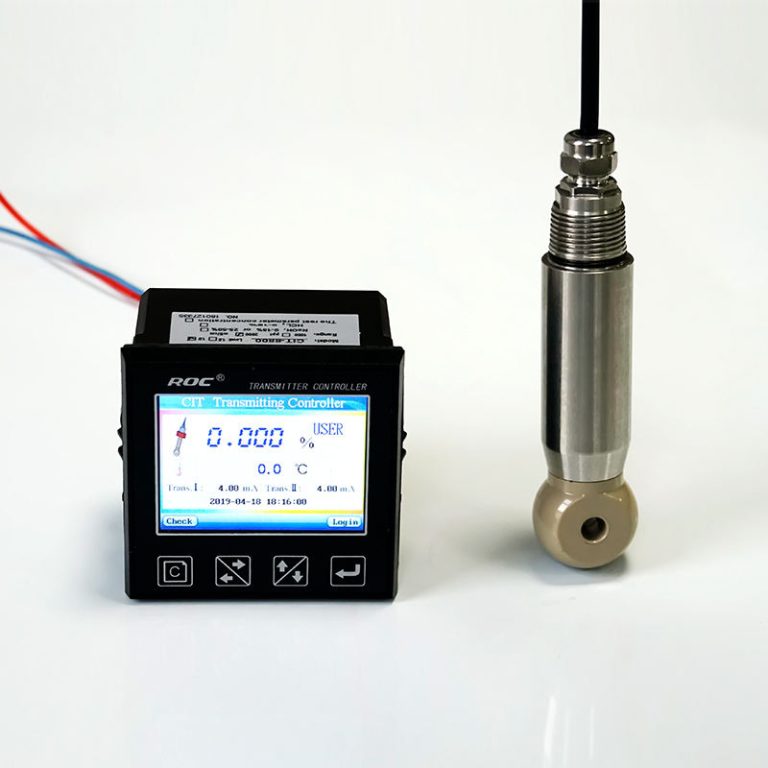
Shanghai ChiMay provides comprehensive instrumentation for MMM system monitoring, including:
- Online turbidity analyzers (0-1000 NTU range)
- Conductivity meters for permeate quality verification
- Multi-parameter sensors for process optimization
- Flow transmitters for flux calculation
Integrity Testing
MMM installations require periodic integrity verification:
Pressure Decay Testing: Detects membrane breaches through pressure loss measurement
Bubble Point Testing: Identifies defects through air breakthrough pressure
Conductivity Scanning: Maps permeate conductivity variations identifying defect locations
Commercial Development Status
Current Market Availability
Commercial MMM products remain limited, with most applications in pilot or demonstration phases:
Asahi Kasei: Metal-based MMM products for gas separation with water treatment variants under development
Mitsubishi Chemical: ZIF-8 incorporated membranes for chemical processing
Specialty Membrane Manufacturers: Several startups developing MMM products for niche applications
Manufacturing Scale-Up Challenges
Commercial MMM production faces technical barriers:
MOF Availability: Current MOF production capacity insufficient for large membrane fabrication
Cost Reduction: MOF costs ($50-500/kg) must decrease by 80-90% for competitive pricing
Quality Consistency: Batch-to-batch variation in MOF properties impacts membrane performance
Module Fabrication: Adapting MMM materials to existing module manufacturing processes
Projected Timeline
Market development projections indicate:
- 2025-2027: Introduction of first commercial MMM products (pharmaceutical and electronics applications)
- 2027-2030: Cost reduction enabling broader adoption
- 2030+: MMM market share of 15-20% of advanced membrane segment
Economic Considerations
Cost-Benefit Analysis
MMM deployment economics versus conventional membranes:
Capital Cost Premium: 20-40% higher than conventional polymeric membranes
Operational Savings: 30-50% reduction in fouling-related costs through enhanced anti-fouling properties
Membrane Life Extension: MOF reinforcement may extend operational lifetime by 20-30%
Treatment Efficiency: Higher flux reduces energy consumption by 15-25%
Total Cost of Ownership
Lifecycle cost modeling indicates:
- Payback Period: 2-4 years for applications with severe fouling challenges
- Net Present Value: 15-30% lower total costs over 10-year operational period
- Breakeven Volume: Applications exceeding 500 m³/day treatment capacity favor MMM economics
Shanghai ChiMay’s monitoring equipment supports lifecycle cost optimization through performance tracking and predictive maintenance.
Conclusion
Mixed-Matrix Membranes incorporating metal-organic frameworks represent a promising approach to enhancing water treatment membrane performance. The demonstrated 40-60% flux improvement, enhanced selectivity, and inherent anti-fouling properties address critical limitations of conventional polymeric membranes.
Commercial MMM development faces challenges including MOF cost reduction, manufacturing scale-up, and quality consistency. However, the projected market growth trajectory and advancing technology readiness position MMMs as significant future contributors to advanced water treatment.
Shanghai ChiMay provides essential monitoring capabilities supporting MMM system deployment, optimization, and performance validation. Online analyzers, turbidity sensors, conductivity meters, and multi-parameter monitoring systems enable the comprehensive instrumentation necessary for successful commercial MMM operations.
Organizations evaluating advanced membrane technologies should monitor MMM commercialization developments, particularly for high-value applications in pharmaceutical manufacturing, semiconductor processing, and challenging industrial wastewater treatment where the performance advantages justify current cost premiums. The convergence of materials innovation, manufacturing optimization, and demonstrated field performance positions MMMs for increasing market relevance through 2030 and beyond.