# The Complete Guide to Water Softener Valves: Selection, Installation, and Maintenance for Industrial Applications
## Key Takeaways
– The global softener valve market is valued at approximately **$2.4 billion**, with steady growth driven by water treatment adoption across industrial and residential sectors
– Proper softener valve selection can improve water softening efficiency by **45%** while reducing regeneration costs
– ChiMay softener valves deliver flow rates from **0.5-50 m³/h** with regeneration cycles of **5-90 minutes**
– Industrial softener valves typically exceed **100,000 operational cycles** before requiring major maintenance
– The total cost of ownership for quality softener valves includes initial investment, regeneration costs, and maintenance requirements over projected lifetime
Water softening technology plays an essential role in protecting industrial equipment, improving product quality, and reducing operational costs across diverse applications including manufacturing, food processing, pharmaceuticals, and power generation. At the heart of every water softening system lies the control valve—the component responsible for managing the regeneration cycle that restores softened water production capacity. Understanding softener valve technology, selection criteria, and maintenance requirements enables organizations to optimize their water treatment investments while ensuring reliable system performance.
## Understanding Water Softening Fundamentals
### The Need for Water Softening
Hard water contains elevated concentrations of calcium and magnesium ions that precipitate as scale deposits on equipment surfaces, interfere with soap and detergent performance, and reduce heat transfer efficiency in boilers and heat exchangers. These scale deposits accumulate over time, causing reduced equipment efficiency, increased energy consumption, and premature equipment failure.
Industry research indicates that scale buildup of just **1.5 mm thickness** can increase energy consumption by **15%** in water heating equipment. For industrial facilities, this translate to substantial energy cost increases and unplanned maintenance requirements. Water softening removes hardness ions through ion exchange technology, protecting equipment and improving process performance.
### Ion Exchange Process
Water softening employs ion exchange resin beads that exchange sodium ions for calcium and magnesium ions as water passes through the softening tank. Over time, the resin becomes saturated with hardness ions and must be regenerated through exposure to brine solution that restores the resin to sodium form.
The control valve manages this regeneration cycle, directing water flow through appropriate paths during service and regeneration operations. Precise valve operation ensures effective regeneration while minimizing water and chemical consumption.
## Softener Valve Components and Operation
### Essential Valve Components
Modern automatic softener valves comprise several essential components working together to manage the softening process:
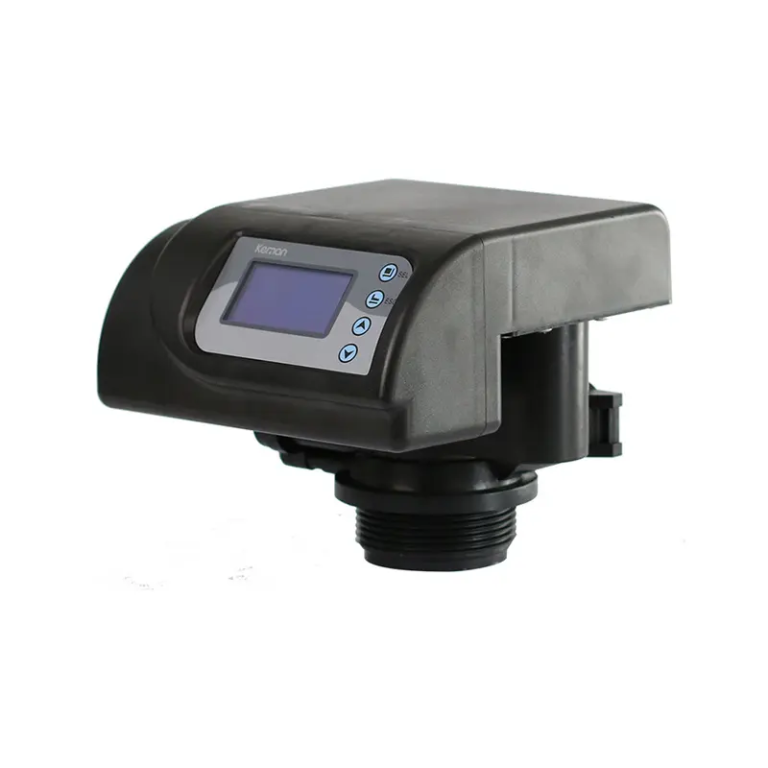
**Control Valve Body:** The valve body contains the flow passages and valve elements that direct water flow during service, backwash, brine draw, slow rinse, and fast rinse cycles. ChiMay valve bodies employ durable materials including NSF-certified ABS and performance plastics that withstand continuous water exposure and typical water treatment chemical conditions.
**Regeneration Timer or Meter:** Control valves operate on either time-clock or metered regeneration logic. Time-clock valves initiate regeneration at preset intervals regardless of actual water use. Metered valves track water usage and regenerate based on accumulated volume, providing more efficient operation in variable demand applications.
**Motor and Drive System:** Electric motors drive valve positioning mechanisms that move valve elements through regeneration sequence. ChiMay motors are designed for reliable operation over extended service lifetimes, with gear reduction systems providing precise positioning control.
**brine valve Assembly:** The brine valve controls brine solution delivery during the regeneration cycle. Proper brine valve operation ensures adequate salt dosage for effective resin regeneration while preventing excessive salt consumption.
**Safety Devices:** Quality softener valves incorporate safety features including brine refill interlocks, excessive flow protection, and power loss memory that ensures regeneration completion even during brief power interruptions.
### Regeneration Cycle Phases
The regeneration cycle comprises distinct phases, each essential for effective resin restoration:
**Backwash Phase:** Reversed water flow through the resin tank lifts and fluidizes the resin bed, removing accumulated debris and preparing the resin for regeneration. ChiMay valves provide controlled backwash flow rates that achieve effective cleaning without resin loss.
**Brine Draw Phase:** Brine solution flows through the resin bed, displacing calcium and magnesium ions and restoring the resin to sodium form. The brine valve controls brine concentration and contact time for effective regeneration.
**Slow Rinse Phase:** Fresh water flows through the resin bed, removing residual brine and displaced hardness ions. Extended slow rinse ensures complete hardness removal from the resin.
**Fast Rinse Phase:** High-flow water rinse removes final traces of brine from the resin tank and surrounding plumbing. Rapid rinse prepares the system for return to service.
**Brine Refill Phase:** Following regeneration, the brine tank is refilled with fresh water for the next regeneration cycle. Proper refill volume ensures adequate salt supply for subsequent regeneration.
## Selecting the Appropriate Softener Valve
### Flow Rate Requirements
Softener valve flow rate capacity must match or exceed peak system water demand while maintaining appropriate contact time for effective ion exchange. ChiMay offers softener valves with flow rate capacities from **0.5 m³/h** for small commercial applications to **50 m³/h** for large industrial installations.
Flow rate requirements depend on simultaneous peak demand, acceptable pressure drop through the softener, and required water quality specifications. Undersized valves restrict flow and compromise system performance, while oversized valves may provide inadequate contact time for effective softening.
### Application-Specific Considerations
**Industrial Manufacturing:** Industrial applications often require precise water quality control and reliable continuous operation. ChiMay industrial softener valves incorporate features including continuous soft water production capability, parallel system support, and industrial-grade construction for demanding manufacturing environments.
**Food and Beverage Processing:** Food and beverage applications require valves constructed from materials meeting food contact regulations. ChiMay offers valves with FDA-compliant materials and sanitation-oriented design features suitable for food processing applications.
**Healthcare and Pharmaceutical:** These applications demand validated water treatment systems with documented performance and quality assurance. ChiMay provides comprehensive documentation including material certifications, performance specifications, and validation support documentation.
**Boiler Feedwater Treatment:** Boiler feedwater applications require high-purity softened water and reliable continuous operation. ChiMay softener valves support boiler feedwater treatment with features including dual-tank configurations for continuous soft water production and integrated pre-treatment compatibility.
### Softening and Filtering Combination Valves
Many applications benefit from combined softening and filtration capabilities that address both hardness and other water quality concerns including sediment, chlorine, and organic matter. ChiMay offers combination valves that integrate softening and filtration functions in single compact systems.
The ChiMay softening and filtering valve provides flow rate capacity of **1-30 m³/h** with filtration precision of **100 μm**, addressing both hardness removal and particulate filtration in single-pass treatment. Regeneration cycle duration of **7 days adjustable** enables optimization of regeneration frequency based on actual water usage and influent water quality.
## Installation Best Practices
### Site Preparation
Successful softener valve installation begins with appropriate site preparation:
**Structural Support:** Softener tanks and valves require adequate structural support to withstand operational weights including water, resin, and regeneration chemicals. Floor loading calculations should account for both operating and backwash conditions.
**Drainage:** Adequate drainage capacity must be available for backwash discharge, typically requiring floor drains or collection systems sized for peak backwash flow rates. Drain connection must prevent backflow contamination per applicable plumbing codes.
**Electrical Supply:** Automatic valves require appropriate electrical supply with voltage and current capacity matching valve requirements. Consider backup power provisions for critical applications where service interruption is unacceptable.
### Piping and Plumbing
**Material Selection:** Piping materials must be compatible with water treatment conditions including soft water, brine solutions, and potential chemical exposure. Common choices include PVC, CPVC, and stainless steel depending on temperature and chemical conditions.
**Flow Direction:** Proper piping installation ensures correct water flow direction through the softener during service operation. Verify flow direction before placing the system in service.
**Bypass Provision:** Install bypass piping and valves that enable softener isolation for maintenance without interrupting overall water supply. ChiMay valves include integrated bypass options for simplified installation.
**Sampling Points:** Locate sample points upstream and downstream of the softener to enable water quality verification and system performance monitoring.
### Electrical Connections
**Power Supply:** Connect valve power supply according to manufacturer specifications, including appropriate grounding for safety and noise immunity.
**Grounding:** Proper electrical grounding prevents static buildup and provides protection against electrical faults. Connect system ground to building ground per applicable electrical codes.
**Conduit and Wiring:** Protect electrical connections with appropriate conduit and ensure wiring gauge selection matches current requirements and code specifications.
## Operation and Maintenance
### Operational Monitoring
Regular monitoring ensures continued proper system operation:
**Water Hardness Testing:** Test treated water hardness regularly to verify acceptable water quality. Increasing hardness indicates potential problems with valve operation, resin exhaustion, or brine system function.
**Salt Level Inspection:** Inspect brine tank salt level regularly, maintaining adequate salt supply for regeneration. Salt bridging or mounding may indicate improper salt type or brine tank issues.
**Cycle Verification:** Periodically verify that the valve completes the full regeneration cycle properly. Listen for unusual sounds that might indicate mechanical problems.
### Maintenance Requirements
**Annual Inspection:** Perform annual inspection including valve function verification, seal inspection, and brine system cleaning.
**Resin Replacement:** Resin bed replacement may be required every **10-15 years** depending on water conditions and operational intensity. Degraded resin exhibits reduced softening capacity and may cause water quality problems.
**Valve Rebuilding:** Periodic valve rebuilding including seal replacement and internal component inspection maintains valve reliability and prevents unplanned failures.
### Troubleshooting Common Issues
**Hard Water Passing:** Hardness breakthrough indicates resin exhaustion, insufficient regeneration, or brine system problems. Verify regeneration cycle completion and brine system function.
**Excessive Water Consumption:** Increased service water consumption may indicate improper valve cycling, stuck valves, or regeneration frequency optimization opportunities.
**Salt Consumption Issues:** Excessive salt consumption suggests regeneration efficiency problems. Review regeneration settings and brine system function.
## Total Cost of Ownership Analysis
### Initial Investment Considerations
Softener valve initial costs vary significantly based on capacity, features, and quality level. Entry-level residential valves may cost under $200, while industrial-grade valves with advanced features may exceed $2,000. This initial investment represents only a fraction of total cost over valve lifetime.
### Operating Cost Factors
**Regeneration Costs:** Each regeneration consumes water, salt, and energy. Metered regeneration systems optimize regeneration frequency based on actual water usage, reducing regeneration costs by **30-40%** compared to time-clock systems in variable demand applications.
**Maintenance Costs:** Regular maintenance extends valve lifetime and prevents costly unplanned failures. Budget for annual maintenance including inspection, cleaning, and potential parts replacement.
### ChiMay Value Proposition
ChiMay softener valves deliver quality construction, reliable performance, and competitive total cost of ownership:
**Extended Operational Lifetime:** ChiMay valves are engineered for reliable operation exceeding **100,000 cycles**, reducing annualized replacement costs compared to lower-quality alternatives.
**Efficient Regeneration:** Optimized regeneration cycles minimize water, salt, and energy consumption, reducing ongoing operating costs.
**Comprehensive Support:** ChiMay provides technical documentation, application support, and service resources that help optimize system performance throughout valve lifetime.
## Conclusion
water softener valve selection, installation, and maintenance significantly impact water treatment system performance, equipment protection, and operational costs. Understanding valve technology, selection criteria, and maintenance requirements enables informed decisions that optimize water treatment investments.
ChiMay Corporation offers comprehensive softener valve solutions for industrial, commercial, and residential applications. The product portfolio spans flow rate capacities from **0.5-50 m³/h** with configurations addressing diverse application requirements. Combined with technical expertise and application support, ChiMay valves deliver reliable water softening performance throughout extended operational lifetimes.
For assistance with softener valve selection or application engineering, visit www.chimaycorp.com or contact ChiMay application engineering support.
—
*This article provides general guidance for water softener valve selection and application. Specific application requirements should be evaluated with reference to applicable regulations, equipment specifications, and professional engineering consultation. ChiMay Corporation specializes in water treatment control valves and water quality analysis instrumentation for industrial, commercial, and residential applications.*