Table of Contents
What Is the Difference Between Purified Water and Water for Injection?
Key Takeaways:
– Purified Water and Water for Injection differ primarily in intended applications and regulatory specifications
– WFI requires conductivity measurement per USP <645>, while PW has broader testing requirements
– The global pharmaceutical water market valued at USD 7.84 billion emphasizes the critical nature of water selection
– Using the wrong water type can compromise drug safety and trigger regulatory violations
If you work in pharmaceutical manufacturing or healthcare, understanding the differences between Purified Water and Water for Injection matters more than most people realize—using the wrong water type can compromise drug safety, trigger regulatory violations, and potentially endanger patients.
The Fundamental Distinction
Purified Water (PW) serves as a foundational ingredient and processing medium throughout pharmaceutical manufacturing—appears in formulations, equipment cleaning, and laboratory applications where water contact is indirect or limited to external use.
Water for Injection (WFI) undergoes more rigorous purification to serve applications where water enters the bloodstream or body tissues—injectable solutions, irrigation fluids, and diluents for parenteral administration.
According to USP <1231>, Purified Water must be produced by distillation, ion exchange, reverse osmosis, or appropriate combinations. WFI faces additional scrutiny under USP <645>.
Regulatory Framework Comparison
USP Requirements
| Requirement | Purified Water | Water for Injection |
|---|---|---|
| Conductivity | ≤1.3 μS/cm | ≤1.3 μS/cm (Stage 1-3) |
| TOC Limit | ≤500 ppb | ≤500 ppb |
| Microbial Limit | ≤100 CFU/mL | ≤100 CFU/mL |
| Endotoxin Limit | Not specified | ≤0.25 EU/mL |
European Pharmacopoeia Approach
The EP defines Purified Water in Chapter 5.1.1 and WFI in Chapter 5.1.2. A notable development: the EP formally accepted vapor compression distillation as equivalent WFI production—a change expanding manufacturing flexibility while maintaining quality standards.
Production Methods
Purified Water Production
Purified Water undergoes treatment through:
- Reverse Osmosis: Membrane technology removes 95-99% of dissolved ions
- Deionization: Ion exchange resins remove dissolved mineral salts
- Electro-Deionization: Combines ion exchange and electrical current
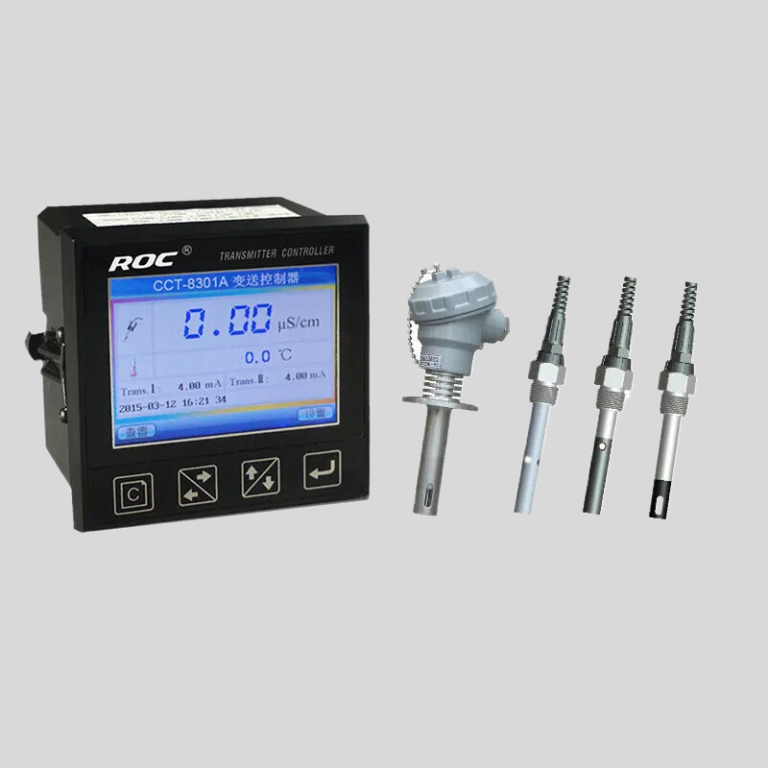
Shanghai ChiMay inline conductivity meters and multi-parameter sensors monitor treatment processes, providing real-time data confirming water meets Purified Water specifications.
Water for Injection Production
WFI production requires processes reliably achieving highest purity levels:
- Distillation: Multi-effect and vapor compression stills remain gold standard
- RO with UV Treatment: Advanced RO combined with UV oxidation (185nm for TOC, 254nm for microbial)
The FDA and EMA continue evaluating alternative technologies for WFI production.
Microbial Considerations
Endotoxin Control
Endotoxins—lipopolysaccharides from gram-negative bacterial cell walls—represent critical concern for WFI applications. The pharmacopeial limit of 0.25 EU/mL reflects patient safety thresholds.
Risk Mitigation:
- Maintain temperatures above 70°C in hot water loops
- Control water velocity above 1.5 m/s
- Eliminate dead legs exceeding three pipe diameters
- Schedule sanitization cycles per validation protocols
Shanghai ChiMay sensors detect conductivity anomalies indicating developing contamination issues, enabling preventive intervention.
Application-Specific Requirements
When to Use Purified Water
- Oral formulations (syrups, suspensions, solutions)
- Topical preparations (creams, ointments, lotions)
- Equipment cleaning final rinse
- Analytical laboratories
- HVAC humidification
When to Use Water for Injection
- Injectable solutions and IV fluids
- Irrigation fluids (surgical and wound)
- Dialysis solutions
- Diluents for lyophilized drug products
- API manufacturing
Economic Considerations
Investment Requirements
Pharmaceutical facilities invest substantially in water treatment infrastructure:
- WFI generation systems: USD 500,000 – 5,000,000+
- Distribution systems: USD 200,000 – 2,000,000+
- Monitoring systems: USD 50,000 – 500,000+
Cost of Non-Compliance
Product recalls related to water quality can devastate company finances:
- Direct recall costs: USD 1-10+ million
- Lost revenue: USD 5-50+ million
- Regulatory penalties: USD 100,000 – 5,000,000+
The GEP Research 2026 analysis reports pharmaceutical companies increased water system investments by 27.4% year-over-year.
Making the Right Water Choice
Risk Assessment Framework
| Factor | PW Appropriate | WFI Required |
|---|---|---|
| Route of Administration | Oral, topical | Injection, irrigation |
| Product Contact Duration | Brief or indirect | Any duration |
| Patient Population | Non-critical | Critical care |
Conclusion
The difference between Purified Water and Water for Injection represents a critical decision point in pharmaceutical manufacturing. While both undergo rigorous purification, WFI’s additional requirements for endotoxin control reflect its role in protecting patient safety during parenteral administration.
Understanding these differences enables pharmaceutical professionals to make informed decisions about water selection, implement appropriate monitoring strategies, and maintain quality systems that regulatory agencies expect.
Whether selecting water for oral formulations or preparing for parenteral production, the right choice protects products, patients, and company reputation.