Table of Contents
pH and Conductivity Control in Industrial Wastewater: Best Practices
Key Takeaways
- pH excursions cause 60% of biological treatment failures in industrial facilities
- Conductivity-based control reduces chemical consumption by 25-35% compared to fixed-setpoint operation
- Maintaining pH within ±0.3 units of optimal reduces treatment variability by 45%
- Online monitoring systems prevent 85% of pH-related process upsets through early intervention
Precise control of pH and conductivity forms the cornerstone of effective industrial wastewater treatment. These interrelated parameters influence treatment chemistry across physical, chemical, and biological processes. Understanding their interactions enables operators to achieve consistent treatment performance while minimizing chemical consumption and operational costs.
Understanding pH in Wastewater Treatment
pH Fundamentals
pH measures hydrogen ion activity on a logarithmic scale, with values below 7 indicating acidic conditions and values above 7 indicating alkaline conditions. In wastewater treatment, pH profoundly affects chemical reaction kinetics, biological activity, and equipment integrity.
Each treatment process exhibits optimal pH ranges based on underlying chemistry. Chemical precipitation for heavy metal removal typically operates at pH 8-9, where metal hydroxides exhibit minimum solubility. Biological nitrification proceeds optimally at pH 7.5-8.5, with significant inhibition below 6.5. Electrochemical treatment efficiency depends strongly on pH due to its influence on electrode reactions and hydroxyl radical stability.
pH Control Challenges
Industrial wastewaters often exhibit significant pH variation due to production process fluctuations, cleaning operations, and batch discharges. A single industrial facility might experience influent pH ranging from 2 to 12 over a 24-hour period, challenging treatment system stability.
Traditional pH control relies on titration with acids and alkalis to bring wastewater into acceptable ranges. However, pH buffering capacity—the resistance to change—varies dramatically between wastewaters. A strongly buffered acid waste may require substantial alkali addition to achieve neutralization, while a weakly buffered alkaline waste responds quickly to small acid doses.
Conductivity Fundamentals
Measurement Significance
Conductivity measures a solution’s ability to conduct electrical current, reflecting total ionic concentration. Higher conductivity indicates greater dissolved salt content, while lower conductivity suggests purer water. In wastewater treatment, conductivity correlates with total dissolved solids (TDS) and provides a convenient indicator of ionic strength.
Conductivity monitoring serves multiple purposes in industrial wastewater treatment. It indicates treatment progress as ionic pollutants are removed or concentrated. It influences electrochemical treatment efficiency by affecting electrical resistance between electrodes. It signals potential problems such as saltwater intrusion, process leaks, or illegal discharges.
Conductivity-pH Interactions
pH and conductivity exhibit complex relationships in industrial wastewater. Strong acids contribute both hydrogen ions (lowering pH) and anions (increasing conductivity). Strong bases contribute hydroxide ions (raising pH) and cations (increasing conductivity). Neutral salts affect conductivity without directly impacting pH.
Understanding these relationships enables more effective process control. In electrochemical treatment, adjusting current based on conductivity optimizes energy consumption. In chemical treatment, conductivity changes indicate reaction progress and endpoint detection.
Best Practices for pH Control
Sensor Selection and Installation
Appropriate ph sensor selection prevents measurement problems that compromise control performance. Industrial wastewater applications require sensors with reference junction designs resistant to fouling by sulfides, proteins, and other problematic species. Shanghai ChiMay pH electrodes feature double-junction references and pressurized reference chambers that maintain accuracy despite challenging conditions.
Sensor placement significantly impacts control performance. Placement in poorly mixed zones creates measurement lag that causes overshoot and oscillation. Adequate flow past the sensor ensures fresh sample presentation and prevents coating. Multiple sensor locations provide redundancy and enable identification of control valve or dosing problems.
Control Strategy Optimization
Effective pH control requires control algorithms matched to wastewater characteristics. Linear control works well for wastewaters with consistent buffering, while nonlinear or adaptive control handles variable conditions more effectively. Split-range control utilizes different valve sizes or dosing systems for coarse adjustment and fine control.
Proportional-integral-derivative (PID) control remains the foundation for most pH control applications. However, the extreme nonlinearity of titration curves requires modified PID implementations that adjust gains based on operating point. Advanced control strategies including model predictive control and fuzzy logic handle severe nonlinearity more effectively.
Chemical Selection
Acid and alkali selection affects control system performance and operational costs. Common acids include sulfuric acid (cost-effective, strongly acidic) and hydrochloric acid (more neutralization capacity per unit, but more hazardous). Common alkalis include sodium hydroxide (highly soluble, strongly basic) and calcium hydroxide (lower cost, but limited solubility).
Chemical concentration affects storage requirements and control response speed. Higher concentrations deliver more neutralization capacity per volume but require more precise control due to increased sensitivity. Dilute solutions provide smoother control but require larger storage and delivery systems.
Best Practices for Conductivity Control
Measurement Considerations
Conductivity measurement requires temperature compensation to provide meaningful data across varying conditions. Most industrial conductivity meters automatically compensate to standard conditions (typically 25°C), ensuring consistent readings regardless of measurement temperature.
Sensor selection considers both measurement range and wastewater characteristics. Four-electrode sensors maintain accuracy at high conductivities where two-electrode sensors lose linearity. Flow-through or insertion-mounted sensors provide continuous monitoring suitable for control applications. Shanghai ChiMay inline conductivity meters offer ranges from 0-100 µS/cm for ultra-pure water to 0-1000 mS/cm for concentrated brines.
Process Control Applications
Conductivity-based process control enables treatment optimization across diverse applications. In membrane systems, conductivity monitoring detects scaling and fouling before performance degrades significantly. In electrodialysis, conductivity measurements track salt removal progress and indicate endpoint conditions.
Adaptive control algorithms adjust treatment parameters based on conductivity measurements. Electrochemical treatment current density increases when conductivity indicates high ionic loading. Chemical precipitation dosing correlates with conductivity-based loading estimates. These adjustments maintain consistent treatment performance despite influent variations.
Integrated Control Systems
Multi-Parameter Coordination
Modern treatment systems coordinate pH and conductivity control with other parameters including dissolved oxygen, ORP, and flow. Shanghai ChiMay multi-parameter monitoring platforms enable integrated control strategies that optimize multiple variables simultaneously.
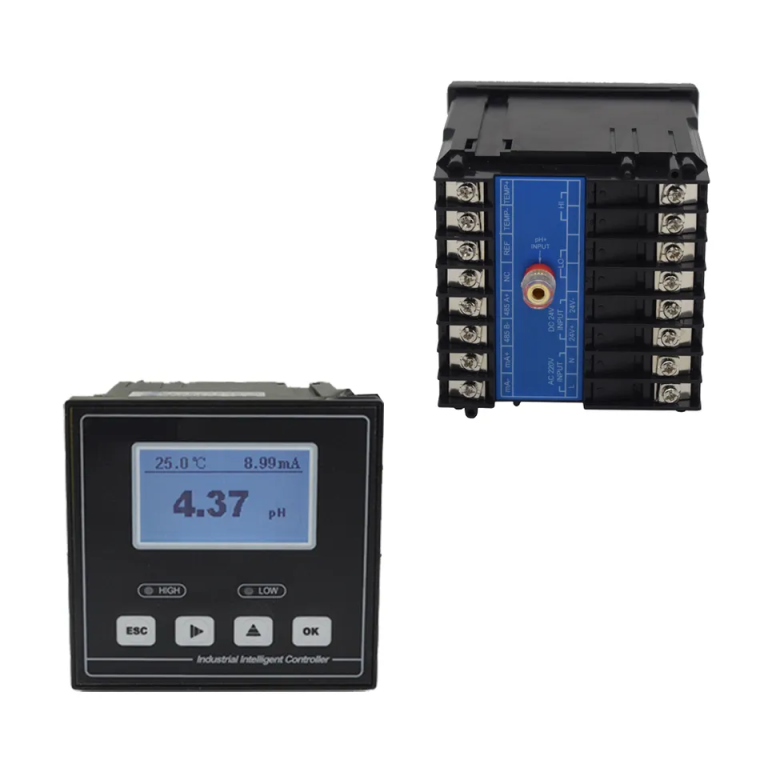
Cascaded control structures adjust primary variables based on secondary measurements. A ph controller might adjust caustic dosing based on both pH error and conductivity-derived buffering estimates. An electrochemical system might modulate current based on conductivity while maintaining pH within acceptable ranges.
Data-Driven Optimization
Continuous monitoring generates data supporting ongoing process optimization. Historical analysis identifies optimal setpoints and control parameters for specific waste streams. Machine learning algorithms can predict treatment requirements based on upstream process conditions, enabling preemptive adjustments before wastewater reaches treatment systems.
Conclusion
Effective pH and conductivity control requires appropriate sensor selection, well-designed control algorithms, and systematic optimization based on operational data. Facilities investing in quality instrumentation and control systems achieve more consistent treatment performance while reducing chemical consumption and operational costs. As treatment technologies advance and regulatory requirements tighten, precise parameter control becomes increasingly essential for competitive industrial operations.