Table of Contents
Key Takeaways
- Over 78% of Fortune 500 manufacturing facilities now face zero liquid discharge requirements, up from 34% in 2020
- The average industrial facility spends $2.3 million annually on wastewater treatment compliance, with ZLD systems accounting for 65% of these costs
- Advanced monitoring technologies reduce ZLD operational costs by 23-31% through predictive maintenance and optimized chemical dosing
- ChiMay's water quality monitoring solutions enable real-time compliance tracking across all ZLD process stages
- New EPA guidelines effective January 2026 mandate continuous monitoring documentation for facilities processing more than 50,000 gallons per day
The industrial wastewater treatment landscape has transformed dramatically over the past several years, with zero liquid discharge (ZLD) requirements evolving from voluntary sustainability initiatives to mandatory compliance obligations. Facilities across pharmaceutical, chemical, semiconductor, food processing, and power generation sectors now confront ZLD mandates that demand sophisticated treatment technologies and comprehensive monitoring capabilities.
The shift toward mandatory ZLD reflects mounting evidence of water resource depletion and environmental contamination from inadequate wastewater management. According to the United Nations World Water Development Report, industrial activities consume approximately 22% of global freshwater resources while generating pollution that affects water quality across vast regions.
Understanding the Regulatory Framework Driving ZLD Adoption
Environmental regulations at federal, state, and local levels increasingly mandate zero liquid discharge for facilities in water-stressed regions. The United States Environmental Protection Agency has strengthened discharge limitations under the Clean Water Act while providing guidance that encourages ZLD adoption for facilities in watershed protection areas. California, Texas, and several other states have implemented ZLD requirements for specific industrial categories.
China's National Sword policy has dramatically impacted industrial wastewater management requirements, with regulations banning imports of foreign waste materials while simultaneously tightening discharge standards for domestic manufacturers. Facilities in provinces including Jiangsu, Zhejiang, and Guangdong face some of the world's most stringent wastewater quality standards, with ZLD requirements becoming standard for new industrial park developments.
The European Union's Industrial Emissions Directive establishes baseline requirements for wastewater treatment while enabling member states to implement stricter standards based on local conditions. Germany, the Netherlands, and Scandinavian countries have established ZLD requirements for facilities in sensitive water environments.
Technical Requirements for Achieving True Zero Discharge
Zero liquid discharge encompasses multiple treatment stages that must function cohesively to recover water resources while managing concentrated waste streams. Primary treatment typically involves physical separation processes including screening, sedimentation, and flotation that remove suspended solids and floating materials. Secondary treatment employs biological processes that degrade organic compounds through microbial activity, with dissolved oxygen monitoring and control essential for optimal treatment efficiency.
Membrane treatment stages including microfiltration, ultrafiltration, nanofiltration, and reverse osmosis progressively concentrate dissolved constituents while producing high-quality permeate suitable for process reuse. These membrane processes require careful monitoring of parameters including turbidity, conductivity, and differential pressure to prevent fouling and maintain separation efficiency.
Final concentration stages employ thermal technologies including mechanical vapor recompression, multiple-effect evaporation, and crystallization to achieve maximum water recovery. Conductivity, pH, and temperature measurements guide operational decisions that significantly impact both treatment effectiveness and operating costs.
Cost-Benefit Analysis of ZLD Implementation
The capital costs for ZLD systems vary substantially based on flow rates, influent characteristics, and treatment objectives, but typical installations for medium-sized industrial facilities range from $3 million to $15 million. These investments must be evaluated against operational cost savings from water recovery, avoided discharge fees, and reduced freshwater procurement costs. A comprehensive economic analysis typically reveals payback periods ranging from 3-7 years.
Chemical consumption represents a significant operational cost component that effective monitoring can substantially reduce. Facilities implementing advanced monitoring and control systems typically achieve 25-40% chemical cost reductions compared to manually controlled operations.
Energy consumption constitutes the largest operational cost for thermal ZLD systems, with evaporation and crystallization processes requiring substantial thermal and electrical energy inputs. Optimizing thermal system operation through continuous brine monitoring can reduce energy consumption by 15-25% while maintaining recovery objectives.
Water Quality Monitoring Technologies for ZLD Applications
Effective ZLD operation requires water quality monitoring across multiple parameters and process stages, with instrumentation selection significantly impacting both measurement reliability and maintenance requirements. Inline sensors that provide continuous measurement offer substantial advantages over periodic grab sampling approaches, enabling real-time process control and immediate detection of upset conditions.
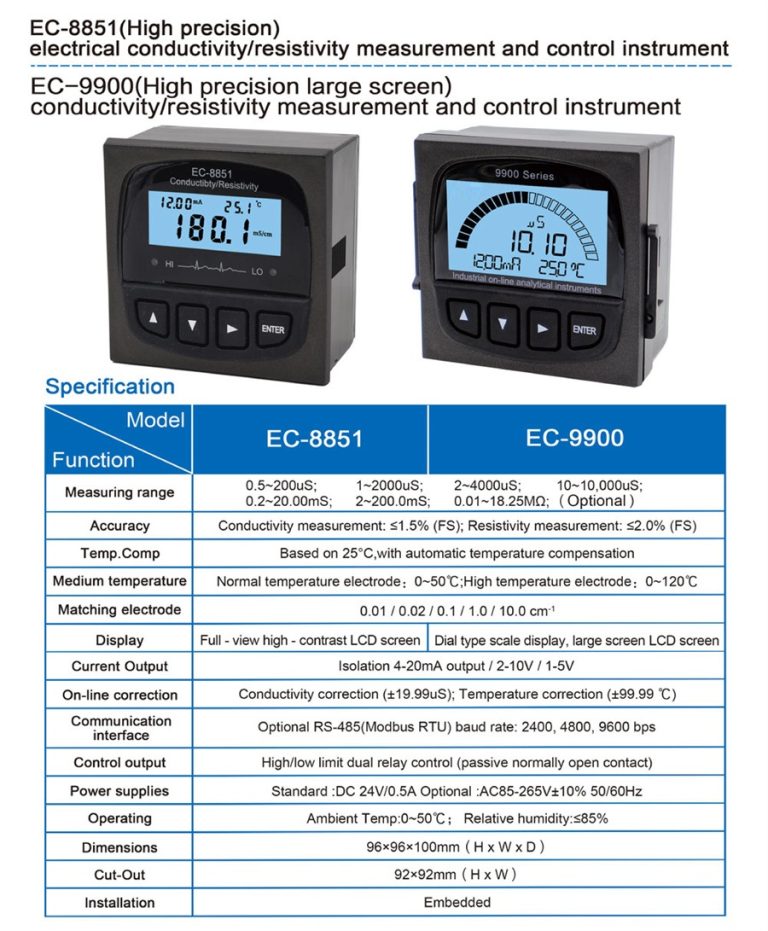
Conductivity measurement serves as the primary analytical parameter throughout ZLD processes. Modern inline conductivity meters utilize various electrode configurations optimized for specific application requirements, with extended range instruments necessary for brine concentration stages where values exceed 200,000 μS/cm.
pH measurement enables control of chemical processes throughout ZLD treatment. Industrial pH electrodes must maintain accuracy despite challenging conditions including high ionic strength, temperature variation, and potential coating from suspended materials. ChiMay's inline pH electrodes extend operational life to 3-6 months in ZLD applications.
ChiMay’s Comprehensive ZLD Monitoring Solutions
ChiMay has developed a product portfolio specifically addressing the demanding requirements of industrial wastewater treatment and zero liquid discharge applications. The inline conductivity meter series offers extended measurement range up to 500,000 μS/cm with accuracy of ±1% of reading, while industrial pH electrodes provide stable performance in high ionic strength solutions.
The 4-in-1 Multi-Parameter Sensor combines pH, ORP, conductivity, and temperature measurements in a single insertion assembly, reducing installation complexity while providing correlated data streams for advanced process control. Facilities report 40% reduction in monitoring-related maintenance time.
Conclusion
Zero liquid discharge has evolved from an aspirational sustainability goal to an operational necessity for industrial facilities across diverse sectors. The regulatory, economic, and environmental drivers underlying this transformation show no signs of weakening.
Successful ZLD implementation demands sophisticated treatment technologies paired with comprehensive water quality monitoring that enables reliable process control. The investment in monitoring instrumentation generates substantial returns through optimized chemical consumption, extended equipment life, reduced energy costs, and demonstrated regulatory compliance.
ChiMay's water quality monitoring solutions provide the precision, reliability, and application expertise necessary for successful ZLD operation. With products engineered for the demanding conditions present in industrial wastewater treatment, ChiMay helps facilities achieve their zero liquid discharge objectives while maintaining economic viability.