Table of Contents
Top 7 Cooling Tower Water Management Solutions for Modern Power Facilities
Key Takeaways
- Power plants implementing comprehensive cooling tower management achieve 35% reduction in water consumption while maintaining optimal heat rejection efficiency
- The cooling tower water management market reaches $3.8 billion globally in 2026, with 15% annual growth driven by water scarcity concerns
- Shanghai ChiMay monitoring solutions address all seven critical management areas with integrated sensors and control systems
- Facilities adopting automated water management reduce chemical treatment costs by $95,000-180,000 annually
- Proper cooling tower management extends equipment service life by 5-8 years, avoiding $450,000-800,000 in premature replacement costs
Introduction
Cooling towers represent one of the most water-intensive components of thermal power generation, with a typical 500 MW facility consuming 100-150 million gallons annually through evaporation and blowdown. Managing these systems effectively requires attention to multiple interconnected factors: water chemistry, equipment condition, treatment program performance, and operational practices. Modern cooling tower water management encompasses seven core solution areas that, when implemented together, deliver significant improvements in water efficiency, equipment reliability, and operational cost control.
The 7 Critical Cooling Tower Water Management Solutions
Solution 1: Continuous Conductivity Monitoring and Control
The Challenge: Traditional blowdown control based on timer schedules cannot respond to actual water quality conditions, leading to either overtreatment (wasting water and chemicals) or undertreatment (causing scale and corrosion).
The Solution: Continuous conductivity monitoring enables automated blowdown control that adjusts water discharge based on real-time mineral concentration measurements.
Key Capabilities:
- Real-time conductivity measurement across operating range of 500-5,000 μS/cm
- Automatic blowdown valve control maintaining target cycles of concentration
- Makeup water integration that accounts for water quality variations
- Alarm notifications when conductivity exceeds acceptable limits
Performance Impact:
- 25% reduction in cooling water consumption
- 30% decrease in chemical treatment requirements
- 60% reduction in scale-related equipment problems
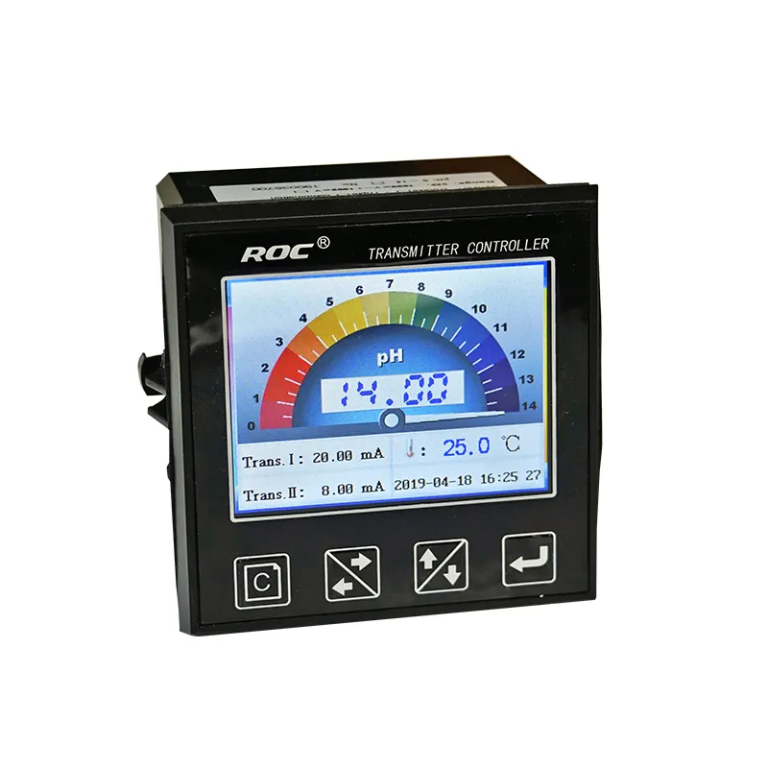
Shanghai ChiMay conductivity sensors feature automatic temperature compensation and polarization-resistant electrode design, providing stable measurements in high-mineral-content cooling water. The integrated transmitter supports both analog (4-20mA) and digital (Modbus) outputs for seamless DCS integration.
Solution 2: Real-Time pH Monitoring and Adjustment
The Challenge: pH affects both scale formation and corrosion rates, but traditional grab sampling cannot capture rapid fluctuations that damage equipment.
The Solution: Continuous pH monitoring enables immediate detection of pH excursions and automated acid or caustic dosing control.
Target Ranges:
| Parameter | Target | Critical Limits |
|---|---|---|
| Recirculating water pH | 6.8-8.2 | 6.5-9.0 |
| Makeup water pH | 7.0-8.0 | 6.5-9.0 |
| Treated effluent | 6.5-9.0 | 6.0-9.5 |
Performance Impact:
- 40% reduction in corrosion-related equipment failures
- 25% improvement in biocide effectiveness
- 15% reduction in scale deposition rates
Solution 3: Automated Biocide Control Systems
The Challenge: Manual biocide dosing based on fixed schedules leads to over-treatment during low-demand periods and under-treatment during contamination events.
The Solution: ORP (oxidation-reduction potential) monitoring provides real-time indication of biocide residual, enabling automated dosing that maintains protection while minimizing chemical consumption.
ORP Control Parameters:
- Target range: 650-750 mV (effective microbial control)
- Dosing trigger: ORP below 600 mV
- Over-dose prevention: Automatic dosing limits prevent excessive treatment
- Logging: Complete control history for regulatory compliance
Performance Impact:
- 45% reduction in biocide consumption
- 70% fewer microbial-related problems
- $35,000-55,000 annual chemical cost savings
Shanghai ChiMay ORP sensors incorporate durable platinum band electrodes with double-junction reference systems, providing reliable measurement in chlorinated cooling water environments.
Solution 4: Corrosion Rate Monitoring
The Challenge: Corrosion damage often remains undetected until catastrophic failure, when repair costs are highest.
The Solution: Electrical resistance (ER) corrosion probes provide continuous measurement of actual metal loss, enabling condition-based maintenance and early intervention.
Monitoring Capabilities:
- Real-time corrosion rate measurement in mils per year (mpy)
- Cumulative metal loss tracking for remaining life assessment
- Trend analysis for predictive maintenance scheduling
- Multiple probe configurations for different materials (carbon steel, stainless steel, copper)
Performance Impact:
- 55% reduction in corrosion-related failures
- 3-5 year extension of cooling tower service life
- $180,000-340,000 annual savings in repair costs
Solution 5: Microbial Control Programs
The Challenge: Biological growth in cooling towers creates biofilm that reduces heat transfer, causes microbiologically influenced corrosion (MIC), and poses health risks from pathogens including Legionella.
The Solution: Comprehensive microbial management combining continuous monitoring, automated treatment, and periodic system cleaning.
Monitoring Parameters:
| Test | Method | Frequency | Target |
|---|---|---|---|
| Total bacterial count | Dip slides/ATP | Weekly | < 10,000 CFU/mL |
| Legionella | Culture test | Monthly | Not detectable |
| Biofilm assessment | Visual inspection | Weekly | No visible biofilm |
| Heterotrophic plate count | Laboratory | Monthly | < 10,000 CFU/mL |
Performance Impact:
- 85% reduction in biofilm-related efficiency losses
- Elimination of Legionella detection events
- 40% reduction in microbial corrosion damage
Solution 6: Flow Measurement and Distribution Monitoring
The Challenge: Uneven water distribution across cooling tower fill reduces effective heat transfer area, reducing overall system efficiency.
The Solution: Flow measurement at critical points enables identification of distribution problems and verification of adequate basin mixing.
Key Measurement Points:
- Makeup water flow: Total water consumption tracking
- Blowdown flow: Verify blowdown system operation
- Basin level: Detect abnormal losses from drift or leaks
- Temperature differential: Monitor heat rejection performance
Performance Impact:
- 10-15% improvement in heat rejection efficiency
- 20% reduction in makeup water consumption
- Early detection of leaks and malfunctions
Solution 7: System Integration and Data Management
The Challenge: Individual monitoring points providing isolated data cannot reveal complex interactions between water quality parameters and equipment performance.
The Solution: Integrated monitoring platforms that correlate data across all measurement points, providing actionable insights and automated optimization.
Integration Capabilities:
- Centralized data historian with trend analysis
- Alarm management prioritizing critical events
- Reporting tools for regulatory compliance
- Dashboard displays for operator awareness
- Predictive analytics identifying developing problems
Performance Impact:
- 40% reduction in alarm-related operator response time
- 25% improvement in treatment program optimization
- $45,000-75,000 annual savings in reduced operator labor
Implementation Considerations
Successful cooling tower water management requires integrated attention to all seven solution areas:
Phased Implementation Approach
| Phase | Duration | Focus | Expected Benefits |
|---|---|---|---|
| Phase 1 | 0-3 months | Monitoring infrastructure | Visibility into system conditions |
| Phase 2 | 3-6 months | Control automation | Chemical consumption reduction |
| Phase 3 | 6-12 months | Optimization | Full efficiency improvement |
Cost-Benefit Analysis
| Investment Area | Typical Cost | Annual Savings | Payback Period |
|---|---|---|---|
| Monitoring sensors | $45,000-80,000 | $85,000-140,000 | 6-9 months |
| Control systems | $35,000-65,000 | $60,000-95,000 | 8-12 months |
| Integration platform | $25,000-50,000 | $40,000-70,000 | 9-14 months |
| Total Program | $105,000-195,000 | $185,000-305,000 | 7-10 months |
Conclusion
Comprehensive cooling tower water management encompasses seven interconnected solution areas that together deliver significant improvements in water efficiency, equipment reliability, and operational cost control. Shanghai ChiMay provides complete monitoring solutions—including conductivity sensors, pH electrodes, ORP transmitters, and corrosion rate probes—designed specifically for cooling tower applications.
Power facilities implementing all seven management solutions consistently achieve 30-40% reductions in water consumption and chemical treatment costs while extending cooling system service life by 5-8 years. In an industry facing increasing pressure from water scarcity and environmental regulations, comprehensive cooling tower management represents an essential investment in sustainable operations.