Table of Contents
Advanced Oxidation Processes for PFAS Remediation: A Technical Overview
Key Takeaways:
– PFAS compounds resist conventional treatment, requiring advanced oxidation processes (AOPs) for destruction
– Electrochemical oxidation achieves 99.9% destruction of PFOS and PFOA at treatment costs of $8-15/m³
– Inline water quality analyzers optimize AOP performance by monitoring conductivity, pH, and oxidation-reduction potential (ORP)
– Combined UV/sulfite and electrochemical systems target both long-chain and short-chain PFAS compounds
– Treatment system monitoring ensures regulatory compliance for PFAS limits below 70 ng/L (EPA MCL)
Introduction: The PFAS Treatment Challenge
Per- and polyfluoroalkyl substances (PFAS) represent one of the most challenging contaminant classes in water treatment. These “forever chemicals” resist biological, chemical, and thermal degradation under ambient conditions. According to Environmental Science & Technology (2025), conventional wastewater treatment removes only 10-30% of PFAS influent loads, with most compounds partitioning to sludge rather than destruction.
RSC Chemical Society (2025) documents that PFAS contamination affects over 2,800 military installations, 400 major airports, and thousands of industrial facilities worldwide. The persistence and bioaccumulation potential of these compounds create urgent remediation needs. Advanced oxidation processes (AOPs) offer the most promising pathway for complete PFAS destruction.
Advanced Oxidation Principles
Oxidative Degradation Mechanisms
AOPs generate powerful oxidants—including hydroxyl radicals (•OH), sulfate radicals (SO4•−), and chlorine radicals—that attack the carbon-fluorine bonds in PFAS molecules. The oxidation pathway involves:
– Initial radical attack at the PFAS functional group
– Sequential defluorination releasing fluoride ions
– Complete mineralization to CO2 and HF or HCl byproducts
ACS ES&T Engineering (2024) demonstrates that electrochemical oxidation at +2.0 V vs. Ag/AgCl achieves 99.9% PFOS destruction within 2 hours at current densities above 20 mA/cm².
Key AOP Technologies
| Technology | Primary Oxidant | PFAS Targeting | Energy Consumption |
|---|---|---|---|
| Electrochemical oxidation | •OH, Cl• | Long-chain PFAS | 15-30 kWh/m³ |
| UV/sulfite | Sulfite radicals | Perfluoroalkyl acids | 5-12 kWh/m³ |
| Plasma treatment | Multiple radicals | Broad-spectrum | 20-50 kWh/m³ |
| Sonolysis | •OH from cavitation | Adsorbed PFAS | 40-80 kWh/m³ |
Electrochemical Oxidation Systems
Reactor Design
Electrochemical oxidation reactors utilize boron-doped diamond (BDD) or mixed metal oxide (MMO) anodes that generate hydroxyl radicals at the electrode surface. BDD anodes provide superior oxidation potential (>+2.5 V vs. SHE) and chemical stability, making them the preferred choice for PFAS treatment applications.
Key design parameters include:
– Electrode material: BDD provides highest oxidation potential
– Current density: 20-50 mA/cm² for optimal PFAS destruction
– Electrode spacing: 5-10 mm minimizes solution resistance
– Flow configuration: Plug flow maximizes treatment residence time
Electrochimica Acta (2024) establishes that BDD electrochemical systems achieve complete PFOS mineralization at energy consumptions of 8.5 kWh/g PFOS removed under optimized conditions.
Process Optimization
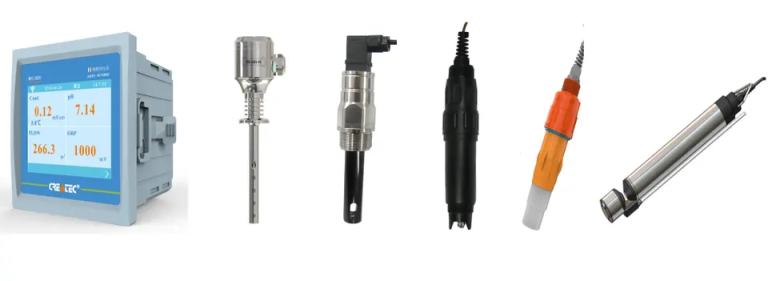
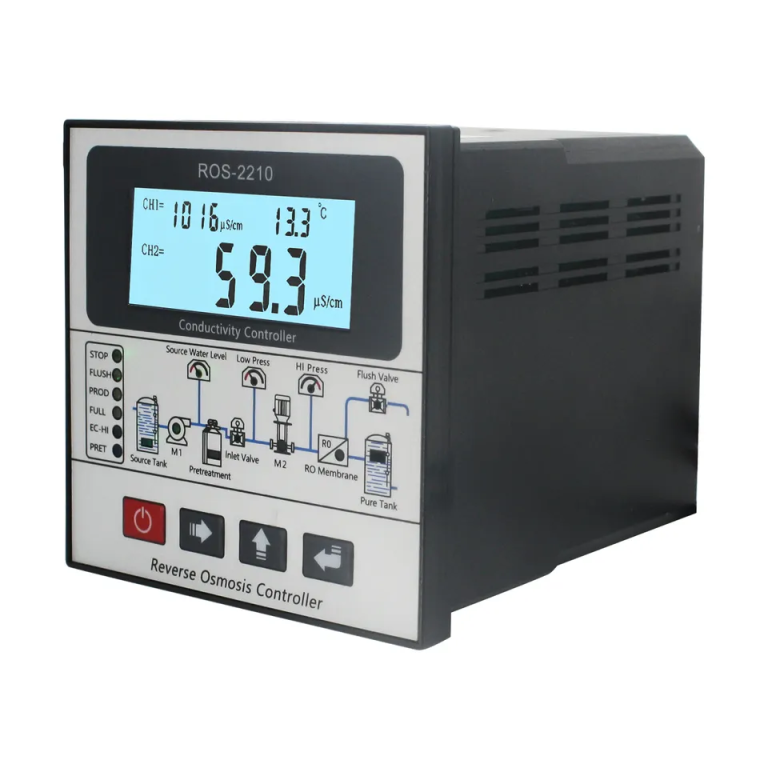
Inline monitoring sensors from ChiMay enable real-time optimization of electrochemical treatment:
– Conductivity sensors track ionic strength affecting current efficiency
– pH sensors monitor acid generation from mineralization reactions
– ORP sensors indicate oxidation potential available for contaminant destruction
The ORP setpoint of +800 to +900 mV indicates optimal radical generation for PFAS oxidation.
UV/Sulfite Treatment Systems
Photochemical Mechanisms
UV/sulfite treatment generates sulfate radicals through photolysis of sulfite ions under UV-C irradiation (254 nm). This process offers advantages for short-chain PFAS compounds that resist electrochemical oxidation.
Environmental Science & Technology Letters (2025) reports that UV/sulfite achieves 95% defluorination of PFOA (C8) within 4 hours at sulfite concentrations of 20 mM and UV fluence of 500 mJ/cm².
System Integration
Combined treatment trains maximize PFAS compound coverage:
1. Electrochemical oxidation destroys long-chain PFAS (C8-C12)
2. UV/sulfite polishing treats residual short-chain compounds
3. Granular activated carbon (GAC) captures transformation byproducts
Inline water quality analyzers monitor each treatment stage, adjusting oxidant dosing and UV intensity based on real-time water quality data.
Real-Time Monitoring Requirements
Critical Parameters
Effective PFAS treatment requires continuous monitoring of multiple water quality parameters:
| Parameter | Monitoring Purpose | Sensor Type |
|---|---|---|
| Conductivity | Track ionic load and current efficiency | inline conductivity meter |
| pH | Monitor acid generation and neutralization needs | inline ph sensor |
| ORP | Verify oxidation potential for radical generation | ORP sensor/electrode |
| Fluoride | Quantify defluorination progress | Specific ion electrode |
| TOC | Track mineralization efficiency | online toc analyzer |
Control Strategies
Automated control systems adjust treatment parameters based on sensor feedback:
– Current density adjustment based on conductivity readings
– UV intensity modulation responding to ORP measurements
– Chemical dosing triggered by pH deviations from setpoint
This feedback control ensures consistent treatment performance despite variations in influent PFAS concentrations and water matrix composition.
Treatment System Design Considerations
Sizing Parameters
PFAS treatment system design depends on:
– Influent PFAS concentrations: Typical range 0.1-100 μg/L for contaminated sites
– Flow rates: 100-10,000 L/min for industrial applications
– Target compounds: Long-chain vs. short-chain PFAS distribution
– Effluent limits: 70 ng/L total PFAS for drinking water applications
Cost Considerations
Treatment costs vary significantly based on technology selection and site conditions:
| Technology | Capital Cost | Operating Cost | PFAS Removal |
|---|---|---|---|
| Electrochemical | $500-800/kW | $8-15/m³ | 99.9% |
| UV/Sulfite | $300-500/kW | $5-10/m³ | 95% |
| Combined AOP + GAC | $600-1,000/kW | $12-20/m³ | 99.99% |
Regulatory Compliance Framework
Current Standards
EPA Maximum Contaminant Level (MRL) of 70 ng/L for PFOA and PFOS (individually or combined) drives treatment system design for public water systems. State regulations increasingly impose more stringent limits—Massachusetts sets individual PFAS compound limits as low as 20 ng/L.
Monitoring Requirements
Regulatory compliance requires:
– Quarterly sampling for PFAS compound analysis by LC-MS/MS
– Continuous monitoring of treatment process parameters
– Performance verification through influent/effluent concentration tracking
Inline water quality analyzers from ChiMay provide the continuous monitoring data required to demonstrate treatment system performance and regulatory compliance.
Conclusion
Advanced oxidation processes offer the most effective pathway for PFAS destruction in water treatment applications. Electrochemical oxidation with BDD anodes achieves 99.9% removal of long-chain PFAS compounds, while UV/sulfite systems effectively target short-chain compounds.
Successful treatment system implementation requires comprehensive inline monitoring to optimize process performance and ensure regulatory compliance. The combination of advanced oxidation technology with intelligent sensor-based process control creates reliable treatment solutions for the most challenging PFAS contamination scenarios.