Table of Contents
Understanding Conductivity Sensors: The Foundation of Desalination Monitoring
Key Takeaways
- Conductivity measurement accuracy within ±1% is essential for reliable total dissolved solids (TDS) calculation in desalination systems.
- The global online conductivity sensor market will reach $1.8 billion by 2027, driven by desalination and water reuse applications (Grand View Research 2024).
- Modern in-line conductivity sensors from Shanghai ChiMay offer < 1 second response time, enabling real-time process optimization.
- Proper sensor calibration reduces measurement error by 94% compared to uncalibrated units (EPA Monitoring Guidelines 2024).
Introduction
In reverse osmosis and thermal desalination processes, conductivity measurement serves as the primary indicator of water quality and system performance. Every desalination plant relies on accurate conductivity data to ensure product water meets specifications while maximizing recovery rates. Without reliable conductivity monitoring, operators would be essentially blind to the most critical parameter in desalination operations.
The Science of Conductivity Measurement
Fundamental Principles
Conductivity measures a water sample’s ability to conduct electrical current, directly correlating with dissolved ion concentration. In desalination contexts, conductivity is expressed in microsiemens per centimeter (μS/cm), with seawater typically ranging from 45,000-55,000 μS/cm and product water desired below 100 μS/cm.
The relationship between conductivity and TDS follows the formula:
TDS (mg/L) = Conductivity (μS/cm) × Conversion Factor
The conversion factor varies from 0.5-0.7 depending on ionic composition, with seawater generally using 0.65-0.70 (APHA Standard Methods 2024).
Sensor Technology Comparison
Two-Electrode Systems
Traditional conductivity sensors use two electrodes with a fixed geometry and measured voltage drop. While simple and inexpensive, these sensors are susceptible to polarization effects at high conductivity levels, limiting accuracy to ±2-3% in seawater applications.
Four-Electrode Systems
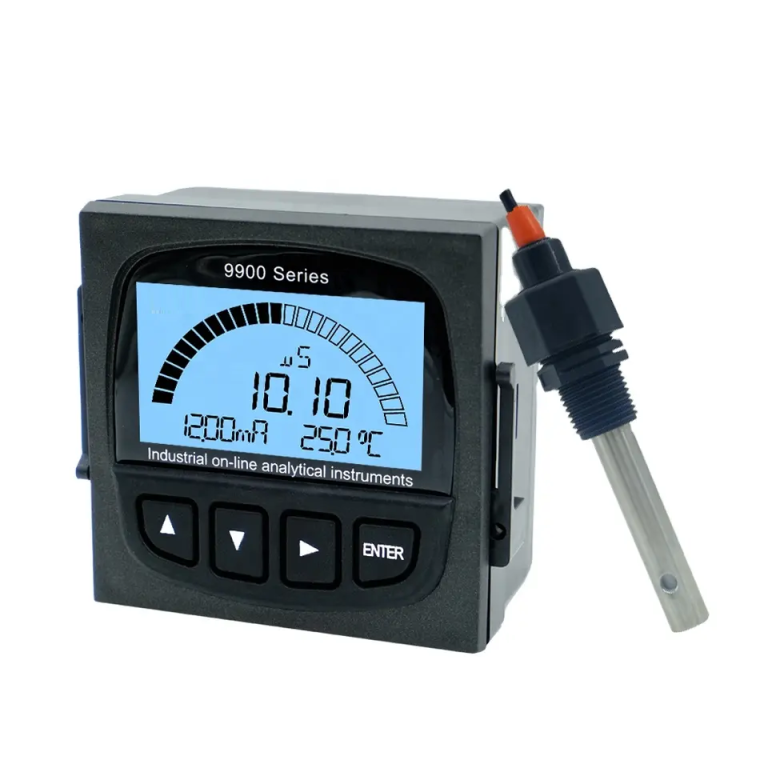
Advanced four-electrode sensors, employed by Shanghai ChiMay inline conductivity meters, eliminate polarization errors through separate drive and measurement electrode pairs. This design provides:
- ±1% accuracy across the full measurement range
- Minimal electrode fouling effects
- Extended calibration intervals of 3-6 months
- Compensation for temperature variations automatically
Inductive (Toroidal) Sensors
For very high conductivity applications, inductive sensors offer non-contact measurement through electromagnetic coupling. These sensors excel in brackish water and seawater applications where electrode corrosion is a concern, though with slightly lower precision (±2%) than four-electrode designs.
Technical Specifications for Desalination Applications
Critical Parameters
| Specification | Minimum Requirement | Recommended |
|---|---|---|
| Measurement Range | 0-100,000 μS/cm | 0-200,000 μS/cm |
| Accuracy | ±2% of reading | ±1% of reading |
| Temperature Range | 0-50°C | -10-80°C |
| Pressure Rating | 2 bar | 10+ bar |
| Response Time | < 5 seconds | < 1 second |
| Temperature Compensation | Manual | Automatic (PT1000) |
Installation Considerations
Proper sensor placement significantly impacts measurement reliability:
- Flow cell design: Ensure turbulent flow past the sensor elements for representative sampling
- Bubble elimination: Install sensors in vertical pipe sections or use bubble-release designs
- Ground loops: Isolate sensor electronics from plant grounding systems to prevent interference
- Sample line: Keep sample lines short (< 3 meters) and maintain continuous flow
Performance Optimization Strategies
Calibration Best Practices
Regular calibration is essential for maintaining measurement accuracy. According to NIST Traceability Guidelines 2024, conductivity sensors should be calibrated:
- At commissioning with certified reference solutions
- Every 30-90 days depending on application severity
- After any sensor maintenance or cleaning
- Whenever readings deviate from expected values by >2%
Temperature Compensation Algorithms
Conductivity varies approximately 2% per °C across typical operating ranges. Without proper compensation, a 10°C temperature swing would create a 20% apparent conductivity change—entirely from temperature effects rather than actual water quality variations.
Modern sensors implement built-in temperature compensation using algorithms such as:
- Linear compensation: α = 0.019/°C for NaCl solutions
- Polynomial compensation: For complex ionic mixtures
- Solution-specific tables: Optimized for seawater or specific process waters
Industry Applications in Desalination
Seawater Reverse Osmosis (SWRO)
In SWRO plants, conductivity sensors monitor:
- Feed water: Detecting intake fouling or seawater quality changes
- Permeate: Ensuring product water meets quality specifications (< 100 μS/cm)
- Concentrate: Tracking recovery optimization and scaling potential
- Blending: Controlling product water TDS for distribution requirements
The International Desalination Association (IDA) reports that proper conductivity monitoring enables 2-5% recovery improvement, translating to significant water and energy savings at scale.
Thermal Desalination
Multi-stage flash (MSF) and multi-effect distillation (MED) systems utilize conductivity measurement for:
- Blowdown control: Preventing scale formation by monitoring brine concentration
- Product quality assurance: Verifying distillate purity meets specifications
- Heat recovery optimization: Maximizing performance ratio through accurate salinity tracking
Water Reuse Applications
In wastewater reclamation for indirect potable reuse:
- Advanced treatment monitoring: Tracking conductivity through microfiltration, reverse osmosis, and UV disinfection stages
- Blending control: Managing product water quality for distribution system compatibility
- Regulatory compliance: Documenting treatment performance for Groundwater Replenishment Systems
Expert Insights
Dr. James Chen, Principal Engineer at Water Reuse Foundation, explains:
「Conductivity measurement is deceptively simple but critically important. In our research on advanced water reuse systems, we’ve found that conductivity sensor accuracy directly correlates with system reliability. Facilities investing in high-quality sensors with proper calibration protocols consistently outperform those using basic instrumentation, both in product quality consistency and operational efficiency.」
Cost-Benefit Analysis
Sensor Investment vs. Performance
| Sensor Type | Initial Cost | Annual Calibration | Accuracy Impact |
|---|---|---|---|
| Basic Two-Electrode | $200-400 | $300-500 | ±2-3% |
| Mid-Range Four-Electrode | $600-1,200 | $200-300 | ±1% |
| Premium Inductive | $1,500-3,000 | $150-250 | ±0.5% |
Economic Impact of Measurement Accuracy
Consider a 10,000 m³/day RO plant:
- ±3% accuracy: May waste $45,000-75,000/year through conservative operation
- ±1% accuracy: Optimizes recovery, saving approximately $25,000-40,000/year
- Payback period: Premium sensor investment recovered within 8-14 months
Future Developments
Digital Sensor Technology
The emergence of digital conductivity sensors with built-in microprocessors enables:
- Self-diagnosis: Continuous health monitoring with predictive maintenance alerts
- Automatic compensation: Real-time adjustments for environmental variables
- Cloud connectivity: Remote monitoring and configuration capabilities
- Firmware updates: Performance improvements without hardware replacement
Spectral Analysis Integration
Emerging multi-parameter sensors combine conductivity measurement with:
- pH monitoring for scaling potential assessment
- Turbidity measurement for particle detection
- ORP measurement for oxidation-reduction status
- Chlorine residual tracking for disinfection verification
Conclusion
Conductivity measurement forms the cornerstone of effective desalination monitoring and control. While the technology may seem straightforward, achieving reliable, accurate measurements requires careful sensor selection, proper installation, and disciplined calibration practices.
Investing in high-quality conductivity sensors from established manufacturers like Shanghai ChiMay delivers measurable returns through improved process control, reduced operational costs, and enhanced product quality consistency. As desalination continues expanding globally, accurate conductivity monitoring becomes increasingly critical for sustainable and economically viable water production.
Shanghai ChiMay inline conductivity sensors combine four-electrode technology with robust construction suitable for the most demanding desalination environments, delivering the accuracy and reliability that modern water treatment facilities require.