Inline pH Sensors for Semiconductor Ultra-Pure Water Applications: A Procurement Guide
Semiconductor UPW applications require inline pH sensors with ±0.02 pH accuracy and sub-second response times
The global ultra-pure water market for semiconductor manufacturing will reach $6.2 billion by 2027, driving demand for precision monitoring equipment
Real-time pH monitoring in UPW systems can reduce particle contamination events by 43% compared to grab sampling
Leading-edge chip facilities now require 18-MΩ·cm resistivity UPW with pH stability within 6.8-7.2 range
Total cost of ownership for UPW pH sensors includes initial purchase, calibration, and particle contamination risk factors
Introduction
The semiconductor industry's relentless push toward smaller process nodes—5nm, 3nm, and beyond—has placed unprecedented demands on ultra-pure water (UPW) quality. Inline pH sensors deployed in these critical applications must deliver laboratory-grade accuracy while surviving the aggressive cleaning chemistries and ultra-low contamination requirements inherent to chip fabrication.
According to SEMI's 2025 Water Management Report, semiconductor fabs consume an average of 2,000 gallons of UPW per wafer start, with pH monitoring representing one of the most challenging analytical measurements due to the near-neutral pH requirements and potential for electrode contamination.
This procurement guide examines the technical specifications, selection criteria, and total cost considerations for inline pH sensors destined for semiconductor UPW applications.
Understanding UPW pH Measurement Challenges
The Contamination Factor
Unlike conventional industrial pH measurement, semiconductor UPW applications present unique challenges where electrode materials and junction designs can introduce metallic contaminants into the water stream. The International Technology Roadmap for Semiconductors (ITRS) specifies maximum metallic impurity levels of 10 parts per trillion (ppt) for key metals, meaning any electrode component that sheds particles or leaches ions becomes a potential yield killer.
Typical contamination sources include:
Glass membrane sodium leaching in traditional pH glass electrodes
Reference junction metal components that can introduce copper, silver, or silver chloride
Sensor body materials that may outgas organic compounds
Cable and connector materials near the measurement point
Temperature Compensation Complexity
UPW pH measurements must account for the precise temperature dependence of the Nernst equation, with sensitivity of approximately -0.003 pH/°C near neutrality. However, semiconductor fab UPW systems typically operate with <0.1°C temperature stability, requiring sensors with advanced auto-compensation algorithms that can track subtle thermal variations without introducing measurement artifacts.
Resistivity Interference
The exceptionally high resistivity of UPW—often exceeding 18.2 MΩ·cm—creates measurement challenges for conventional pH electrodes. The high resistance of the glass membrane (typically 200-1000 MΩ at 25°C) makes the system susceptible to electrical noise, requiring careful consideration of grounding, shielding, and signal conditioning.
Technical Specification Requirements
Accuracy and Stability Standards
Procurement specifications for semiconductor UPW pH sensors should mandate:
Materials of Construction
The sensor body and wetted materials must be selected to eliminate contamination sources:
Hydrogenated amorphous silicon nitride or quartz for the electrode housing
Fluoropolymers (PFA or PTFE) for O-rings and seals
Ion-track-etched glass or solid-state ISFET technology for the pH-sensitive membrane
High-purity titanium or Hastelloy for any metal components in the flow cell
Dr. Sarah Chen, Senior Process Engineer at a leading Taiwan foundry, notes: "We rejected three sensor suppliers before finding one that could pass our 72-hour particle shedding test. The cost of a single yield-affecting contamination event far exceeds any sensor price premium."
Comparative Analysis: Glass vs. Solid-State Electrodes
Traditional Glass Electrodes
Conventional pH measurement relies on glass membrane technology that has served industrial applications for over a century. However, glass electrodes present several concerns for UPW service:
Advantages:
Proven accuracy and long-term stability
Wide measurement range capability
Lower initial cost compared to solid-state alternatives
Extensive application history and support documentation
Disadvantages:
Sodium ion exchange in the glass membrane (sodium error)
Potential for glass particle generation during cleaning cycles
Higher impedance requiring premium signal cables
Brittleness and sensitivity to thermal shock
Alkaline error at high pH values
Industry data from McCracken et al., Ultrapure Water Journal (2024) indicates that glass electrodes in continuous UPW service show measurable sodium contamination levels of 5-15 ppt after 30 days of operation.
Solid-State ISFET Sensors
Ion-Sensitive Field Effect Transistor (ISFET) technology offers an alternative approach that eliminates many glass electrode limitations:
Advantages:
No glass membrane eliminates particle generation risk
Fast response time (<1 second typical)
Low impedance signal output improves noise immunity
Compact size enables integration into micro-volume flow cells
No alkaline error at high pH
Disadvantages:
Higher initial cost (typically 1.5-2x glass electrode pricing)
Temperature coefficient requires precise compensation
Limited long-term stability data in UPW applications
Susceptibility to light-induced photocurrents
Newer technology with fewer qualified suppliers
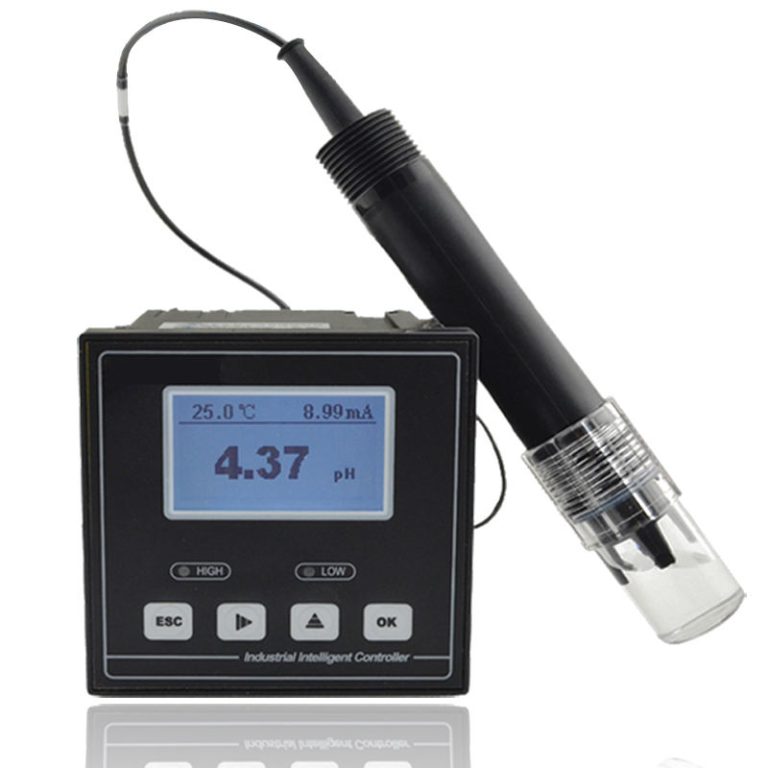
For semiconductor UPW applications, ChiMay's solid-state inline ph sensor technology provides the contamination-free measurement capability required for advanced node fabrication, with integrated temperature compensation and digital output for seamless SCADA integration.
Total Cost of Ownership Considerations
While initial sensor price represents an important procurement factor, the total cost of ownership (TCO) analysis must incorporate:
Direct Costs
Sensor acquisition: $800 – $3,500 per unit depending on technology
Installation hardware: Flow cells, mounting brackets, cable runs ($200 – $800)
Calibration standards: pH buffer solutions traceable to NIST ($150 – 300/year)
Replacement frequency: Glass electrodes typically 12-18 months; ISFET sensors 18-36 months
Maintenance labor: Estimated 4-8 hours per year for calibration and cleaning
Indirect Costs
Calibration-induced downtime: Each calibration event removes the sensor from service
Particle contamination risk: A single yield-affecting contamination event can cost $50,000 – $500,000 depending on affected wafer volume
Process excursions: pH excursions outside specification can trigger full UPW system dumps, costing $10,000 – $50,000 per event
Analytical delays: Reduced measurement frequency increases risk of undetected excursions
TCO Comparison Example
For a typical 300mm fab running 50,000 wafer starts per month, the TCO comparison over 5 years favors high-quality sensors:
The 56% TCO reduction with premium sensors demonstrates that procurement decisions should prioritize total cost over unit price.
Supplier Qualification Requirements
Before finalizing procurement, ensure suppliers can provide:
Particle shedding test data meeting SEMI F63 or equivalent standards
Metallic impurity leach testing for the specific sensor configuration
Long-term stability data from similar semiconductor applications
Application engineering support for installation and commissioning
Calibration traceability to NIST pH reference standards
Response time verification under actual UPW flow conditions
Warranty terms covering material defects and premature failure
Conclusion
Selecting inline pH sensors for semiconductor UPW applications requires balancing measurement accuracy, contamination risk, and total cost of ownership. While budget sensors may appear attractive on initial price, the potential costs of particle contamination and process excursions can far exceed any unit price savings.
Procurement specifications should mandate strict accuracy requirements (±0.02 pH), contamination-free materials of construction, and comprehensive supplier qualification testing. ChiMay's inline pH sensor product line meets these demanding requirements with solid-state measurement technology specifically designed for semiconductor UPW service.
For quotation requests or technical consultations regarding UPW pH measurement solutions, contact ChiMay application engineering at your earliest convenience.